

Flying with an infant: seats and bassinet requests before booking
A practical confirmation sheet for an infant’s ticket, separate seat and bassinet request across the whole journey.
Language
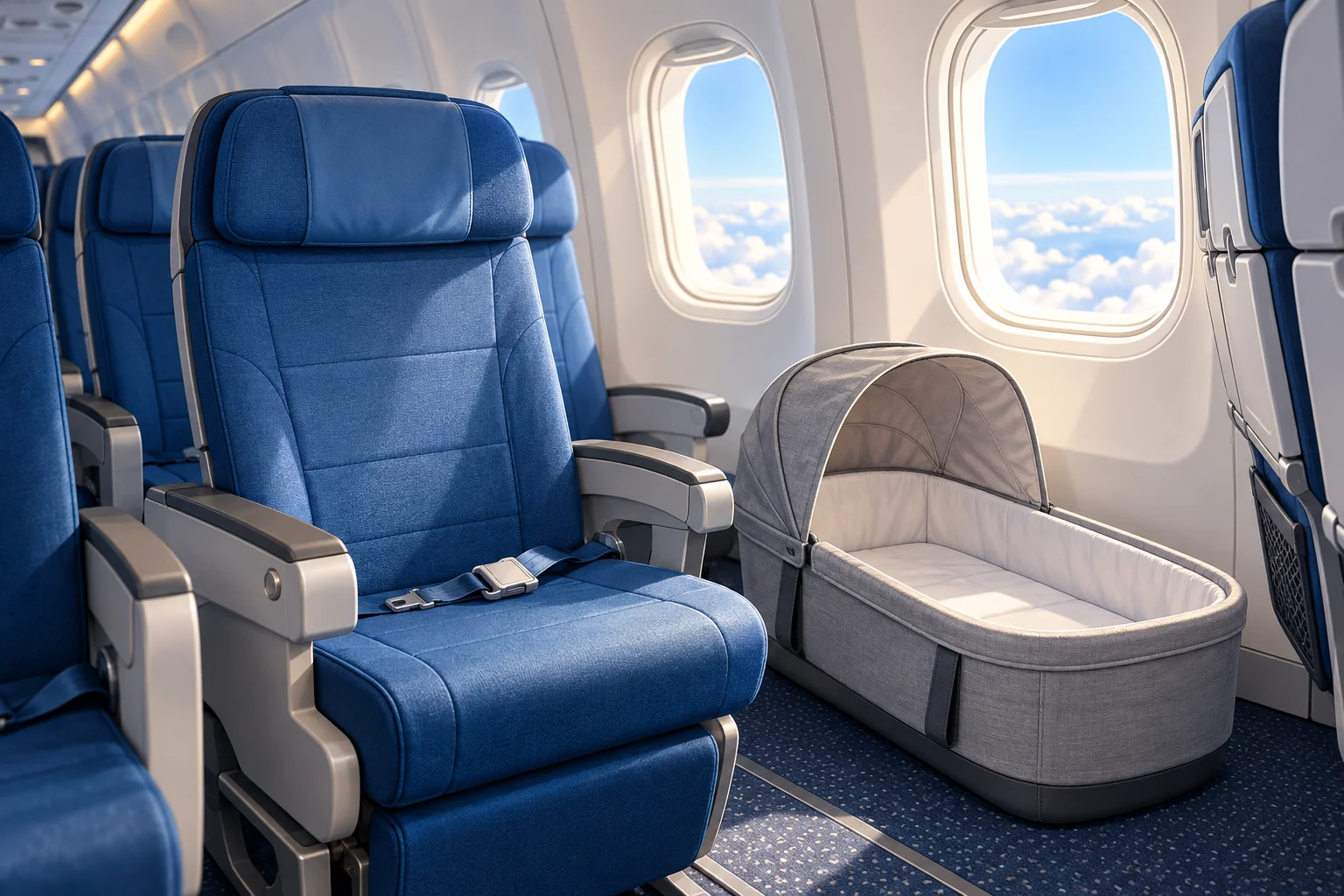
Before booking a flight with an infant, establish three separate things: the passenger category used for the ticket, whether the child has a purchased seat, and whether any requested bassinet is available and suitable under the operating airline’s rules. These are different arrangements. A passenger listed in a booking does not, by itself, prove that a separate seat is included. Equally, selecting a location in the cabin does not confirm that a bassinet will be supplied.
The useful starting point is your actual itinerary, rather than a general list of family travel tips. Write down the child’s date of birth and the dates of every flight, including the return and any connecting services. Then ask the relevant airline or booking agency to explain the permitted arrangement for that journey. This guide helps organize that conversation. It does not decide medical fitness, approve a restraint device, promise a particular price or replace the operating airline’s instructions.
Make an age record for the whole journey
Create one line per flight with the departure date, flight number, operating airline and the child’s age on that date. Include services on separate tickets as well as connections within one booking. Keep dates clear: a return departure after a birthday can change the question you need to ask. Do not enter a younger age merely because the outward flight occurs before the birthday. Your information should describe the journey that will actually take place.
KLM provides a useful carrier-specific example. Its child-ticket page considers age across the trip, including the return, and directs customers to contact it when a child turns two during the journey. That is a reason to investigate the issue early; it is not a rule to copy automatically to another airline. Ask how your chosen seller will issue the complete itinerary and which seating arrangement applies. Record the answer beside the dates rather than leaving it as a vague verbal assurance.
Separate the ticket from the seating arrangement
Ask whether the quoted infant ticket is for travel on an accompanying adult’s lap or includes a separately purchased seat. Use those descriptions explicitly. The word “infant” alone is not enough to identify what you are buying. If you want a separate seat, ask how that purchase is arranged and what accompanying equipment or conditions apply. An online form that offers an infant passenger category may not support every possible seating arrangement through the same booking steps.
For example, KLM’s published process asks customers to contact its contact centre to arrange an extra seat for a baby. Emirates separately describes lap travel and a purchased seat with an accepted child seat. These short examples illustrate why the purchase channel and seating conditions matter. They do not establish worldwide entitlement, device acceptance or a universal fare. Confirm the arrangement for your actual flight before deciding that the quote meets your needs.
Verify a restraint with the operating airline
If your plan involves bringing a child restraint for a purchased seat, identify the actual product before asking for approval. Keep its model, relevant markings and dimensions available for the airline’s assessment through its official process. A description such as “car seat” is too broad to settle compatibility. Do not assume that acceptance in a car, on a previous flight or by one airline means acceptance on another service. The airline can explain its requirements for your aircraft and booking.
Keep device acceptance separate from paying for the seat. Payment alone does not answer whether the device can be used or where it may be installed. Ask what information is needed, when it must be supplied and how a confirmation will be recorded. Follow the carrier’s instructions for use; this article is not an installation guide. If a requirement remains unresolved, leave it marked as unresolved on your comparison sheet instead of treating the equipment as already accepted.
Treat a bassinet as its own request
A bassinet request is not interchangeable with purchasing a child’s seat. Ask whether the flight offers bassinets, which eligibility and size conditions apply, how the request is made and what level of confirmation is possible. Availability can be limited. Distinguish a request being recorded from the service being guaranteed. Read the actual confirmation language carefully and ask what it means for that flight. A cabin seat map alone cannot answer every part of this question.
Emirates states that its bassinets have particular dimensions and limited numbers. KLM also describes a request process with availability that it cannot guarantee until boarding. Those are carrier examples, not a promise that all airlines use the same limits or procedure. The practical lesson is to identify what has been requested, what is confirmed and what remains conditional. Do not plan the entire journey around an assumed bassinet that your airline has not confirmed in the way you expect.
Check every operator and every segment
A booking can include more than one operating airline. Note who actually flies each segment, rather than relying only on the brand displayed at the top of the offer. Ask whether the infant ticket, seating arrangement and any equipment request are accepted on each service. A confirmation for the outward flight does not explain the return. A confirmation for one operator does not automatically cover its partner. Keep separate answers when the conditions differ.
This is also where you assess how much coordination an itinerary requires. Compare the number of services and the unresolved arrangements for each option. A shorter connection or a lower displayed fare cannot settle an infant-seating question. Avoid turning this into an invented ranking of “best airlines for babies.” You are checking whether a specific trip can be organized with clear conditions. If the seller cannot explain an important part, ask the operator through its appropriate channel before proceeding.
With your passenger dates and seating needs written down, you can compare flights for the journey you actually need. Travlaza supports search and comparison. The selected airline or travel agency handles the booking, payment, ticket issuance and reservation support. A search result is a starting point for checking the chosen offer; it does not itself confirm a bassinet, approve equipment or arrange an infant’s separate seat.
Build a before-payment confirmation sheet
For each option, record the passenger category, seat included or not included, purchase channel, operating airline, equipment check and bassinet request status. Add the written conditions that matter to your decision and the contact route for questions. Use “unknown” where an answer is missing. Unknown does not mean free, unavailable or approved. Keeping that distinction prevents an incomplete offer from appearing simpler than a fully explained one.
Compare actual quoted totals for the same arrangement. If one offer includes a purchased seat and another assumes lap travel, they are not equivalent offers merely because they share dates and destinations. If an extra purchase is required, ask for its actual amount and terms rather than inserting an estimated fee. Keep baggage and ordinary paid seat-selection questions separate. The confirmation sheet should make the infant arrangement understandable without repeating every detail of the general fare rules.
Decide what a conditional request means for you
Consider a hypothetical family choosing between two itineraries. One has a recorded bassinet request that remains subject to availability; the other has a different seating arrangement whose equipment conditions still need clarification. Neither option is “confirmed suitable” simply because it appears in a comparison. The family first identifies which unanswered question would change its decision, then obtains the relevant answer from the operator or seller. This example contains no real price or prediction of availability.
If you are willing to travel under the permitted arrangement without a bassinet, state that clearly in your planning notes. If your decision depends on a specific service, ask what can actually be confirmed before payment and what alternatives are permitted if the request cannot be fulfilled. Do not assume that a request creates a refund right or that a seat can be added later without conditions. Read the applicable terms and ask the seller to explain the consequences for your booking.
Keep the record useful after booking
Save the ticket confirmation and the relevant service-request responses together. Check that the child’s details, flights and recorded arrangements agree. If an aircraft, operator, date or itinerary changes, revisit the affected questions. A change can require another conversation about seating or equipment compatibility; the original answer may describe a different service. Avoid submitting contradictory requests through multiple channels without explaining the existing booking. Use the booking reference privately with the responsible airline or agency.
Does an infant ticket automatically include a separate seat?
No. Confirm whether the offer describes lap travel or a separately purchased seat and how that arrangement is issued. A child appearing as a passenger is not sufficient evidence of an included seat. If you want to purchase one, ask about the booking channel and the operating airline’s equipment conditions before paying.
Is a bassinet guaranteed once I request it?
A request and a guarantee are different. Ask the operating airline what eligibility, availability and confirmation conditions apply to your flight. Read the status recorded in your booking and establish what alternatives are permitted if the request cannot be fulfilled. Do not infer a universal guarantee from a seat map or a paid seat choice.
What if my child turns two during the trip?
Show the seller the date of birth and every flight date before purchase. Ask which category, fare and seating arrangement apply across that itinerary. KLM, for example, directs customers to contact it in this situation; other airlines’ conditions must be checked separately. Do not assume that the outward age applies unchanged to the return.
More travel guides
Is paying to choose your flight seat worth it?
Paying for a seat choice can be useful when it meets a clear need. Check what you are buying, what remains uncertain and the cost for your whole trip.
Compare flight baggage allowances before you book
A cheaper ticket can cost more once you add the bags you need. Check the actual allowance and compare complete offers before paying.

Night flight or day flight? Compare the whole arrival day
Compare two door-to-door timelines before choosing a night or day flight. Check local dates, onward transport, accommodation access and the full cost.