

Online check-in or airport check-in: what to do before your flight
Know what online check-in completes, what still happens at the airport and how to prepare your boarding pass, documents and baggage.
Language
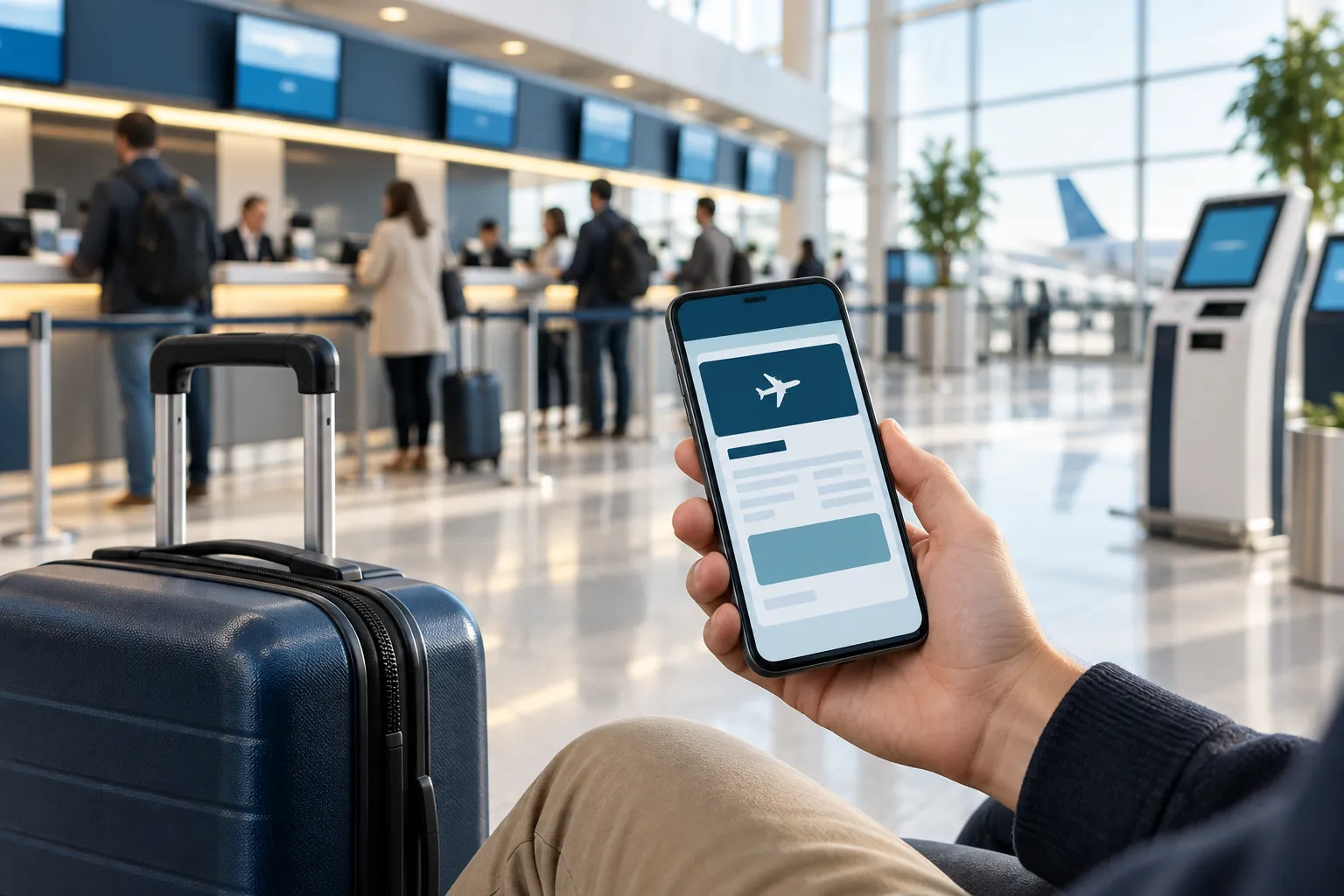
Checking in online completes part of your airline's departure process before you reach the airport. It does not check a suitcase into the hold, replace travel documents or cancel airport deadlines. Airport check-in uses a counter or a self-service kiosk instead. Your next step depends on whether you have a valid boarding pass, checked baggage or an instruction to have documents inspected. Start with those three questions rather than assuming that an online confirmation means you can arrive just before departure.
For an English-speaking traveller leaving a UK airport, “online check-in”, “bag drop” and “boarding” describe different tasks. Understanding that distinction is especially useful on a first flight or when moving between airlines. This guide gives you a practical way to organise the journey without treating one airline's rules as a universal timetable. Read the instructions attached to your actual booking before deciding which airport queue you need.
Booking confirmation, check-in and boarding pass
A booking confirmation records the journey you bought. Check-in is a later step for the flight you are about to take. A boarding pass is the document or mobile pass you use during the departure process. Keep the confirmation and the boarding pass easy to distinguish on your phone. Naming a saved file by flight date and passenger can be more useful than leaving several similar attachments in an email folder.
Look for the operating airline on the booking, particularly if the ticket was sold by another airline or a travel agency. Do not keep entering the agency's reference into a carrier's form if it is not recognised. Check whether the confirmation also contains an airline booking reference. If the journey has several legs, identify the first operating flight and read its check-in instructions before starting.
Prepare before the check-in window opens
Make a small departure note containing the travel date, airport, terminal, flight number and operating airline. Add the booking reference and the spelling of each passenger's name. Keep the note somewhere private; a booking reference and a surname should not be shared publicly. The purpose is to have reliable information beside you when a form asks for it, not to create another document you must carry.
Compare the names with the travel documents you will actually use. Check the document requirements for your itinerary through the appropriate official channels, rather than assuming that being able to open a booking confirms permission to travel. If you notice a name problem or a missing document, deal with the airline or the ticket issuer before departure. Completing another online form is not a substitute for resolving that issue.
Complete the airline's online process carefully
Use the airline's own website or app and select the correct flight and passengers. Read each screen before accepting optional services. A seat selection, an extra bag or an upgrade may have its own conditions and price. Online check-in is not a reason to buy something you do not need. Equally, do not remove an essential baggage option just to finish the process quickly.
At the end, check what you received. A message saying that check-in was started is different from a usable boarding pass. Confirm the passenger name, date, flight and departure airport on each pass. If the system tells you to collect a pass or present documents at the airport, save that instruction as well. This gives you a clear next step instead of an uncertain assumption about whether the process worked.
Read three deadlines separately
Write down the airline's recommended airport arrival time, the check-in or bag-drop closing time and the boarding or gate deadline. They do different jobs. A closing time is the end of a service, not a sensible target for arriving outside the terminal. Allow for the route from the airport entrance to the relevant counter, security and your gate.
Check these details for the departure airport and your particular flight. Do not transfer a deadline from a previous domestic journey to an international one, or from one terminal to another. If the flight time changes, read the carrier's instructions rather than deciding yourself that every check-in deadline has moved. For an unfamiliar airport, a cautious plan also includes finding the terminal and understanding the transfer from the station or car park.
Choose your first airport stop
If you have a boarding pass, no bag to check and no instruction requiring a counter visit, follow the airline and airport directions towards security. If there is a document-check instruction, complete it first. The useful question is not simply “Have I checked in?” but “Is there anything the airline still needs me to do before security?” That question helps avoid both an unnecessary queue and a missed required check.
For British Airways, the current guidance distinguishes hand-baggage passengers from those using bag drop, and it also describes document checks for certain departures. That is an example of why conditions matter, not a promise about every UK flight. If your booking is with another carrier, use that carrier's current instructions. When unsure, ask staff which queue handles your specific outstanding task.
Online check-in does not deliver your suitcase
A checked suitcase still needs to be handed over at the appropriate airport point. Look for the designated bag-drop area, or the counter the airline tells you to use. Have the boarding pass and required documents ready. If there is a self-service machine, follow its instructions and confirm that your bag has actually been accepted before walking away. A printed baggage label alone is not the same as a completed handover.
Keep the baggage receipt with your travel records. Review the bag allowance before leaving home so that you are not trying to solve a size or weight question while others wait behind you. Special or oversized baggage may follow a different route, so check that separately. This guide explains the workflow; it does not set a universal weight limit or say that every airport has the same equipment.
Make your boarding pass usable when you need it
Follow the airline's instructions for a mobile or printed boarding pass. A booking screenshot is not a replacement for the correct pass. Download the approved pass if that option is provided, and check that you can open it without searching through a long email conversation. Keep the phone charged and the screen readable. A paper backup is useful only when it is an accepted form for your journey.
Do not assume that a mobile pass is accepted at every departure airport. Some journeys require a printed pass or a further check before a pass is issued. If you cannot access the document, seek the carrier's help at the airport using the recommended arrival plan. Do not promise yourself that staff can resolve every problem at the gate after the earlier deadlines have passed.
When online check-in is unavailable
First check that you are within the correct window and using the right airline reference and surname. Then read the error or instruction precisely. A required document inspection, an unavailable service and an unrecognised booking are different situations. Keep a note of what the system says, but avoid repeatedly changing passenger details in an attempt to force it to accept the booking.
Use the operating airline's stated alternative, which may involve an airport counter. If there is uncertainty about the booking itself, contact the airline or ticket issuer rather than treating a failed online check-in as proof that the flight is cancelled. Preserve enough time for airport assistance. Any fee for airport service depends on the airline, fare and circumstances; do not assume it is always free or always chargeable.
Organise families and connecting flights
For a family booking, check that every intended traveller is included and has the appropriate pass or clear collection instruction. Save the documents in an order you can use at each checkpoint. If you share one phone, decide who will hold it and keep the group together when the passes are needed. Travellers who may become separated should know how to access their own documents where the airline permits this.
For connections, check which flight legs have passes and what remains to be collected. Do not infer baggage routing from the fact that several flights appear in the same email. Ask the airline about the itinerary and baggage arrangements when unclear. Special assistance should be arranged using the provider's process before departure; online check-in should not be treated as an automatic request for assistance.
A short departure checklist
- Confirm the operating airline, airport, terminal and travel date.
- Prepare the correct booking reference and passenger documents privately.
- Read the check-in window and the separate airport, bag-drop and gate deadlines.
- Save each usable boarding pass and any required counter instruction.
- Choose security, document check, check-in or bag drop according to your situation.
- Keep the baggage receipt and watch the airport's current departure information.
Travlaza helps you search and compare flights before you book. After booking, the selected airline or agency manages the reservation, and the operating airline provides the departure instructions. A well-organised check-in plan connects those stages: know the flight you bought, understand what is still required and reach the right place with time to complete it.
Is online check-in the same as booking a flight?
No. Booking creates the reservation; check-in is a departure step for that flight. Keep the booking confirmation and boarding pass distinct, and follow the operating airline's instructions for when and how to check in.
Can I skip the counter after checking in online?
Sometimes, if you have an accepted boarding pass, no checked baggage and no required counter or document check. Follow the instructions for your airline and departure airport instead of assuming that this applies to every journey.
Do I still need bag drop after online check-in?
Yes, if you are travelling with a suitcase that must go into the hold. Online check-in does not hand over the bag. Use the designated airport point within its deadline and keep the receipt after acceptance.
Does online check-in let me arrive at the airport later?
It may remove one task, but it does not remove security, document checks, baggage deadlines or the gate deadline. Plan from the carrier's recommended arrival time for your flight, with a margin for your airport journey.
What if the airline does not issue my boarding pass online?
Read the instruction and use the airline's stated alternative, often an airport counter or document check. Keep the message and booking details available. A missing online pass alone does not establish that your reservation or flight has been cancelled.
More travel guides

Name on your flight ticket: check it against your passport before paying
A practical prepayment check to separate ticket formatting from a real name error and ask the right provider before booking.

Codeshare flights: check the operating airline before you book
The airline on a flight number may differ from the airline flying the aircraft. Use this practical checklist to understand the offer before paying.

Compare flight baggage allowances before you book
A cheaper ticket can cost more once you add the bags you need. Check the actual allowance and compare complete offers before paying.