

Chicago · Airport guide
O’Hare vs. Midway: Which Chicago Airport Should You Choose?
Compare ORD and MDW for your Chicago hotel, CTA route, arrival time, baggage and return flight before choosing an airport.
By Travlaza Editorial · Reviewed
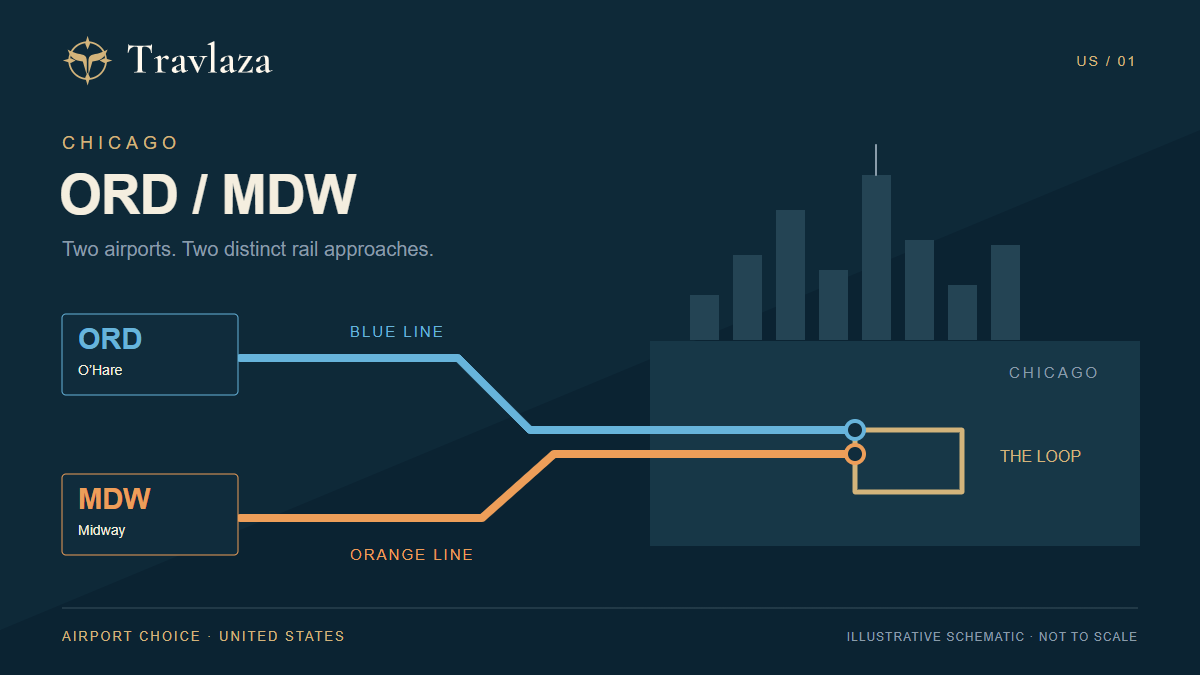
Illustrative airport and transport overview; not a navigation map.
Choose Midway when its flight schedule works and your destination is convenient to the Orange Line. Choose O’Hare when its flights fit your trip better, your destination works with the Blue Line, or overnight train availability matters. Neither airport is automatically the cheaper or easier choice. Compare the flight you can actually book, then trace the trip all the way to your hotel or other destination.
For a Loop stay, Midway has a useful transit advantage: CTA describes the normal Orange Line ride downtown as 20–25 minutes, compared with 40–45 minutes on O’Hare’s Blue Line. Those are train journey estimates under normal service, not landing-to-hotel times. Baggage collection, getting to the station, waiting for a train and reaching your final address come on top.
The differences that matter before booking
| Decision | O’Hare (ORD) | Midway (MDW) |
|---|---|---|
| Train to downtown | CTA Blue Line; normal ride 40–45 minutes | CTA Orange Line; normal ride 20–25 minutes |
| Overnight train availability | Blue Line runs 24 hours daily | Orange Line does not run overnight; CTA identifies N62 Archer bus as an alternative |
| Reaching the airport station | Terminals 1–3 connect to the lower-level station; Terminal 5 requires an ATS ride to Terminal 2 | Enclosed walking connection from the terminal to the station |
| Best practical comparison | Your actual arrival terminal, Blue Line stop and final transfer | Your actual arrival time, Orange Line stop and final transfer |
Start with your Chicago address, not the word downtown
Find the address where you will spend your first night and the place you must leave from on departure day. A hotel described as downtown may still require a second train, a bus or a substantial walk after you reach the Loop. If you are attending an event, use its actual entrance rather than the neighborhood name. The useful question is how many steps separate the airport terminal from that entrance while carrying your bags.
CTA currently lists the State/Lake elevated station as closed for reconstruction, with reopening scheduled for 2029. For a Loop address near that station, compare Clark/Lake or Washington/Wabash instead. CTA directs transfers between the Red Line at Lake and the Loop elevated lines through Washington/Wabash. Map the walk from the operating station to your address, and check elevator alerts if you need step-free access.
For a hotel near an Orange Line stop, Midway’s shorter train ride may translate into a simpler arrival. For an address conveniently reached from the Blue Line, O’Hare may avoid a transfer even though the initial ride takes longer. For a suburban visit or a rental car trip, the downtown comparison may have little relevance. Price the route to the actual address and ask your host which access point or pickup location to use.
Do this separately for the return journey. A sightseeing trip might end at a different hotel, while a work trip might finish at an office across town. The airport that works well on arrival can be less useful on departure. A mixed-airport itinerary is reasonable if it solves both journeys, but remember where your parked car, rental agreement or stored luggage will be.
Understand the airport-to-train portion
At O’Hare, CTA’s station is in the lower-level concourse serving Terminals 1, 2 and 3. Follow airport signs for CTA trains or trains to the city. If you arrive at Terminal 5, CTA directs passengers to take the Airport Transit System to Terminal 2 before following the signs to the Blue Line. That extra stage matters when comparing an international arrival with a domestic itinerary: the train’s published downtown journey does not include your terminal transfer.
At Midway, the Orange Line station has an enclosed walking connection to the terminal. You still need to get off the aircraft, collect any checked bag and walk to the station. If stairs or long corridors are difficult, inspect the complete accessible route, including the station nearest your destination. An accessible airport station does not tell you whether every elevator elsewhere on your route is operating that day.
Is Midway always faster for downtown Chicago?
No. Its normal Orange Line ride is shorter, but an inconvenient flight arrival, a wait for baggage, service disruption or a final transfer can erase that advantage. Compare your terminal-to-address journey at the actual arrival hour, then consider the flight’s departure time and any connection.
Late arrivals and early departures can reverse the decision
The Blue Line operates around the clock; the Orange Line has an overnight gap. That distinction can make O’Hare useful if you want to retain a train option after a late arrival. It does not guarantee frequent trains or an uninterrupted trip during planned work. Check the route schedule and alerts for your date, including the service you need after a delayed landing.
For Midway, check the last usable Orange Line departure rather than assuming an evening flight leaves enough time. The N62 overnight bus alternative is a different journey, with its own stops and travel time. If you would use a car instead, include that realistic backup in your budget before buying the flight. An early return flight deserves the same check in reverse: work back from the airline’s airport arrival recommendation and bag-drop deadline, not merely from takeoff.
A practical test is to move your expected airport exit one hour later and see whether the itinerary still works. This is a planning exercise, not a prediction of delay. If the revised arrival would force a costly transfer or an overnight stay, a slightly more expensive flight at a better hour may offer better value. Travelers with fixed appointments should put more weight on this margin than travelers whose first evening is flexible.
Compare flight quality before comparing the fare
First compare nonstop options on the dates you need. If one airport gives you a workable nonstop and the other adds a connection, look beyond the airport transfer savings. Consider the extra flight segment, the connection length, the departure hour and the arrival time. There is no reason to assume either airport offers the better schedule for every origin: inspect the actual search results for your route.
Then compare the same baggage and fare conditions. A lower displayed fare may have different carry-on rules, seat costs or change restrictions. Add ground transportation for everyone in your party and both directions. If someone is driving you, include the inconvenience of two airport trips in your decision even when you are not paying that person. Before paying, check which bags and seats the selected fare includes, then confirm the ground journey for the whole group in each direction.
Three common Chicago trips
For a weekend near the Loop, suppose both airports offer convenient nonstop flights with similar baggage allowances. Start by checking the walk from each train’s nearest useful stop to your hotel. If the Midway route is direct and the Orange Line is operating when you arrive, the shorter rail segment is a concrete reason to prefer MDW. Do not add a speculative taxi saving when you actually intend to take the train.
For a late-night visit, suppose the O’Hare flight costs more but you can use the Blue Line after leaving the terminal. Compare that complete option with the Midway flight plus the overnight transport you would genuinely choose. A solo traveler and a group sharing one vehicle may reach different decisions. Use current quotes and schedules; neither the group size nor the airport name alone establishes which choice costs less.
For a trip to see family outside central Chicago, ignore the Loop train times until you know whether you will go there at all. Ask about the pickup plan, check rental pickup and return arrangements if relevant, and compare flight schedules against your host’s availability. An airport that looks less convenient on a downtown travel chart may work well for the address you actually need.
Avoid building an airport change into a tight connection
ORD and MDW are separate airports. A booking that arrives at one and departs from the other adds a landside transfer, another check-in process where required and departure security. You also need to establish who is responsible if the first flight is late. Do not interpret a citywide airport search as confirmation that every combination makes a workable connection. Read our self-transfer booking guide before accepting a separate-ticket itinerary.
Should I search ORD and MDW separately?
Yes, if your first search does not clearly show both. Keep dates, passenger count, bags and fare conditions consistent. Compare the flight timings and the journey to your address before choosing. A citywide result can be useful, but confirm the airport code on every flight and on the return.
Can I arrive at Midway and leave from O’Hare?
Yes, when the flights and ground travel suit your plans. Check the entire round trip and any rental car return charge. This is much easier to assess when the airport change happens across a city stay rather than between connecting flights.
Before paying, confirm the airport code, departure date, baggage rules and airline deadlines. Recheck CTA schedules, planned work and elevator alerts close to travel. Compare flights on Travlaza once you know which airport journeys work for your trip. Travlaza compares flight options; booking and payment are completed with the airline or booking agency you select.
Put your airport choice to work
Compare flights for the same dates, baggage needs and destination address. Confirm current airport access, transport service and fare conditions before booking.
Search flights for your trip