

Flying with a power bank: check the label, every airline and your cabin bag
A power bank that fits in your bag is not automatically accepted on your flight. Work through the label, operating airlines and packing plan before departure.
Language
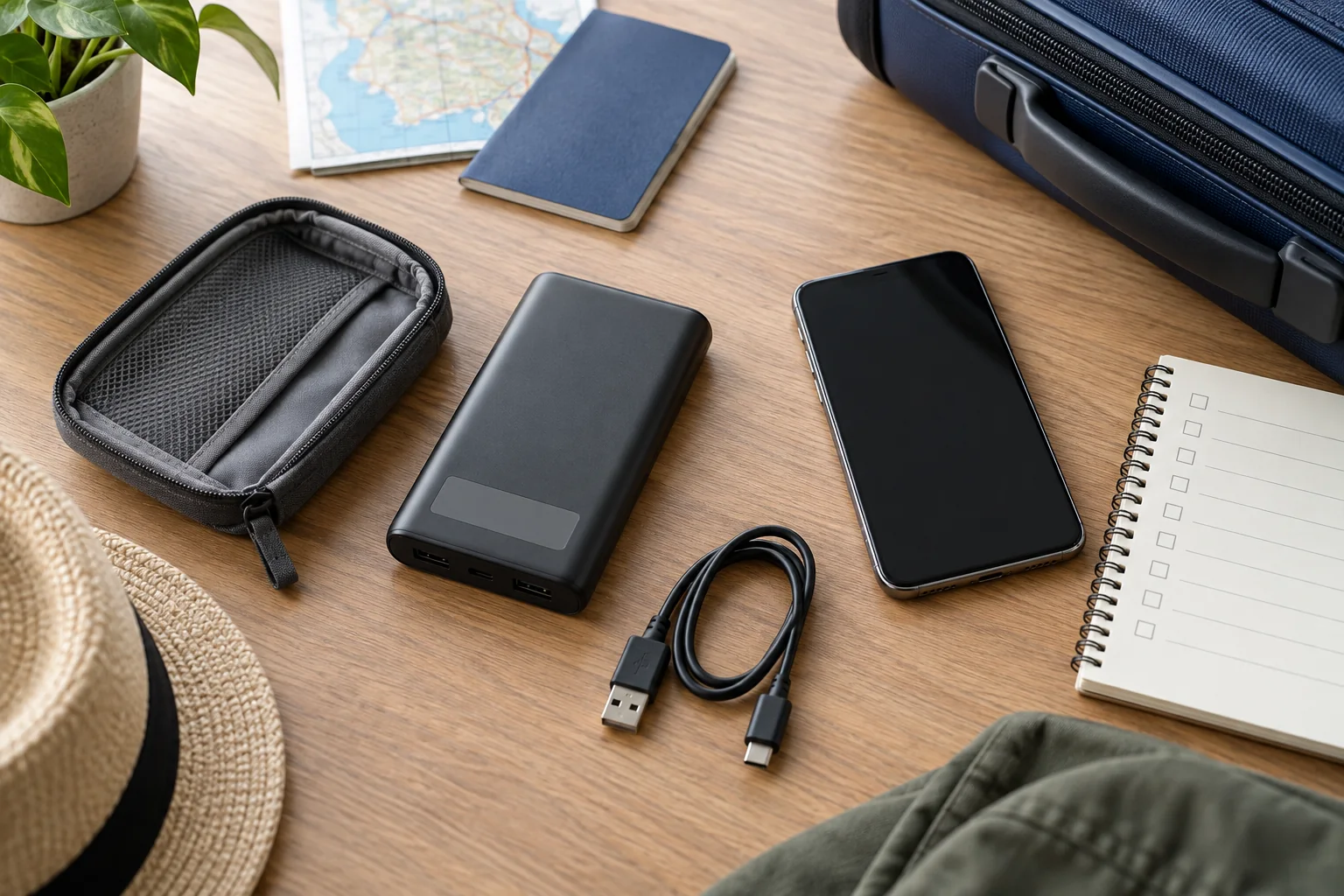
Take a power bank in your cabin baggage, not in a checked suitcase, and check the current rules of every airline actually operating your flights. Acceptance depends on more than the number printed on the sales box: capacity, quantity, readable markings, condition and airline restrictions all matter. Carrying a portable charger does not necessarily mean you may use it to charge your phone, or recharge the power bank itself, during the flight.
This guide was checked on 15 October 2026. Power-bank requirements have changed during 2026, and older advice about spare batteries can be misleading when applied to portable chargers. Use the steps below to prepare a private checklist for your actual journey. It is a way to organize questions, not an airline approval, a safety certificate or a battery-checking feature provided by Travlaza.
Start with the device, not a generic airline-safe claim
Find the manufacturer's model name and the original capacity label on the power bank. Photograph the label while it is readable and keep the manufacturer's specification available. A shop description saying travel friendly, a familiar brand or a previous successful trip does not establish that this particular unit meets today's requirements. Check the unit you will actually pack, rather than a similar product with a different capacity.
If the label has rubbed away, ask the manufacturer and the airline what evidence they require before departure. Do not create a replacement capacity sticker yourself or assume a screenshot will substitute for a required device marking. Give customer service the model and a clear photograph; an answer about an unnamed power bank may not address your device at all.
Separate watts, watt-hours and milliamp-hours
Watts, shown as W, describe power, such as a charger's output capability. Watt-hours, shown as Wh, describe stored energy. A large output number is not the battery's Wh rating. Milliamp-hours, or mAh, need a corresponding battery voltage to express energy. That is why comparing a sales-page mAh number with an airline's Wh limit can produce the wrong conclusion.
Use the manufacturer's stated Wh rating whenever possible. Do not take a USB output voltage, combine it with an unrelated capacity figure and present the result as official proof. If the specification is unclear, send it to the airline or manufacturer rather than guessing. A number at or below a commonly quoted threshold is only one check: quantity, condition, marking and operating-carrier rules still apply.
Do not treat a capacity band as automatic permission
The general passenger guidance commonly uses 100 Wh as an important threshold. Above 100 Wh, do not assume that obtaining approval is always possible: some airlines do not accept larger power banks, and power-bank provisions are not interchangeable with those for batteries installed in equipment. Ask the actual operator for its current instructions before making your packing decision. Do not carry an uncertain device to the airport expecting staff to make an exception.
The same caution applies to articles that promise a universal 100–160 Wh allowance. Guidance, national implementation and individual airline restrictions are not identical. Check the date as well as the device category. A statement about a camera's fitted battery, a mobility aid or a medical device does not automatically answer a question about a portable phone charger. Those other devices require their own relevant guidance.
Check the number of power banks separately
ICAO announced specifications effective from 27 March 2026 limiting personal power banks to two per passenger and prohibiting recharging them during flight. Do not read the two-device figure as a guaranteed allowance on every carrier. An airline can set a lower limit, and the relevant national and route requirements still need checking. A general statement about many spare batteries is not a power-bank allowance.
For a concrete carrier example, Southwest's published requirements checked on 15 October 2026 limit each customer to one power bank, effective 20 April 2026, with a maximum of 100 Wh. That illustrates why a general two-unit summary is insufficient. Confirm the operator's live instructions for your own travel date instead of transferring one airline's rule to another.
List every operating airline, including the return
Write down the company operating each sector, not just the company whose name appears most prominently on the booking page. Connections, codeshares and a separately booked onward flight can introduce another operator. Check the return journey too. One company's confirmation does not settle a different airline's restrictions, even when all flights appear in a single itinerary.
For each operator record capacity, quantity, required markings, storage location, permitted use and any approval process. Add the date you checked and the official page or response you used. If one sector will not accept the device, plan before departure how to travel without it or use a genuinely accepted alternative. Do not assume an airport transfer desk can resolve an incompatible packing plan.
When choosing a journey, compare flight options on Travlaza with the actual operating airlines and connection arrangements in mind. Then check each airline's battery requirements directly. Travlaza helps you compare flights; it does not approve equipment, issue battery permissions or change an operator's safety policy. The selected airline or travel agency handles the booking and ticket.
Use a small, specific check sheet
| Check | What to record | What not to assume |
|---|---|---|
| Device | Exact model, original Wh label, condition | A brand or shop description proves acceptance |
| Each flight | Actual operator and current power-bank instructions | One carrier's answer covers the whole journey |
| Quantity | Number allowed for this device category | A spare-battery allowance applies to power banks |
| On board | Storage, phone-charging and bank-recharging rules | Permission to carry means permission to use |
| Bag handover | Where the charger stays if the bag is checked | Cabin baggage can always remain in the cabin |
Pack for protection and access
Keep the power bank in your cabin baggage with protection against short circuits and physical damage, following the manufacturer's and airline's instructions. Avoid leaving it loose among keys, coins or other items that could contact exposed terminals. A suitable separate pouch or protective packaging helps organize the item, but is not a substitute for checking whether the device itself is accepted.
Know where it is before approaching the gate. Follow the airline's actual storage instructions; some restrict overhead-bin storage. Do not bury it in an inaccessible bag simply because that bag is technically in the cabin. Your packing plan should let you follow staff directions without unpacking an entire suitcase in a boarding queue.
Remove it before a cabin bag goes into the hold
A carry-on bag may be taken at the gate or beside the aircraft to travel in the hold. Before handing it over, tell staff about the power bank and remove it so it stays with you in the cabin in an allowed location. A cabin-baggage tag or the bag's original intended use does not make a portable charger acceptable in checked baggage.
If you realize after handover that the power bank is still inside, inform airline staff immediately and follow their instructions. Do not conceal the mistake or assume that a short flight makes it unimportant. Prepare for the possibility in advance by keeping necessary battery items accessible and understanding which bag will remain with you.
Carrying, using and recharging are three different questions
Ask separately whether you may carry the power bank, use it to charge another device, and recharge the power bank from aircraft power. ICAO's March 2026 announcement addresses recharging the bank itself. Airlines may also prohibit using it to charge a phone. IATA's operator guidance distinguishes the requirement against recharging the bank from a recommendation against using it to recharge another device; carrier instructions can be stricter.
For example, the Arabic Etihad guidance checked for this article prohibits both onboard power-bank use and recharging. Southwest's checked guidance prohibits recharging the bank from in-seat power and sets visibility conditions when it is used. These are carrier-specific examples, not permission for your flight. Follow the instructions of your actual operator and crew rather than reasoning from what another passenger is doing.
Prepare phone access without relying on onboard charging
Before leaving, charge your phone and save the travel information you need in a form you can access without a network connection. Consider an allowed printed copy of essential booking information and note how to contact the ticket issuer. This reduces dependence on finding a working socket at the airport or at your seat. Do not assume that a particular aircraft or seat will provide usable power.
As a hypothetical example, you have two power banks but a connecting operator accepts only one. Resolve that difference at home, before the first flight, and plan how the phone will last through the connection. The worksheet helps reveal the problem; it does not create a right to carry the second unit or guarantee airport storage, shipping, return or disposal services.
Check condition and ask a question staff can answer
Do not travel with a swollen, damaged or recalled battery. Check the exact model against relevant manufacturer recall information, not just the brand name. If a device becomes hot or starts smoking in the cabin, notify the crew immediately and follow their directions. Do not improvise repairs, cooling or disposal. If it falls into a seat mechanism, call the crew instead of moving the seat to retrieve it.
A useful preflight enquiry identifies your operating flights, travel date, model, Wh rating and number of units. Ask which carriage, marking, storage and use conditions apply, and whether written approval is required or available. Retain the answer with its date. If the itinerary or operator changes, review it again. A vague assurance that batteries are allowed is not an answer to all these questions.
Frequently asked questions
My power bank says 65 W. Does that tell me whether it is allowed?
No. The W figure describes power, not necessarily stored energy in Wh. Find the original Wh rating and exact model specification, then check the operator's power-bank requirements. Do not infer acceptance from output wattage, a marketing claim or an unrelated mAh conversion.
Can I leave the power bank in a carry-on bag that is taken at the gate?
No: remove the power bank before the bag goes into the hold and keep it in the cabin as the airline directs. Tell staff if the bag has already been handed over with the charger inside. A bag that began as carry-on becomes checked baggage when it is placed in the hold.
If one airline accepts it, is it accepted on my connecting flight?
Not automatically. Check every actual operating carrier, including onward and return sectors. Capacity, quantity, marking, storage and onboard-use requirements can differ. An approval or allowance for one airline does not authorize carriage with another.
Does permission to carry a power bank mean I can charge my phone in flight?
No. Carrying it, using it to charge a phone and recharging the bank itself are separate matters. Airlines may prohibit use even when carriage is allowed. Check the current instructions before departure and follow crew directions on board; another passenger's actions are not evidence of permission.
More travel guides
Compare flight baggage allowances before you book
A cheaper ticket can cost more once you add the bags you need. Check the actual allowance and compare complete offers before paying.

Codeshare flights: check the operating airline before you book
The airline on a flight number may differ from the airline flying the aircraft. Use this practical checklist to understand the offer before paying.
Online check-in or airport check-in: what to do before your flight
Know what online check-in completes, what still happens at the airport and how to prepare your boarding pass, documents and baggage.