

Flying with fishing rods: carry-on or checked baggage?
Measure the packed rod case, choose cabin or checked carriage, and compare the full baggage cost. Delta and American show how the decision can change.
Language
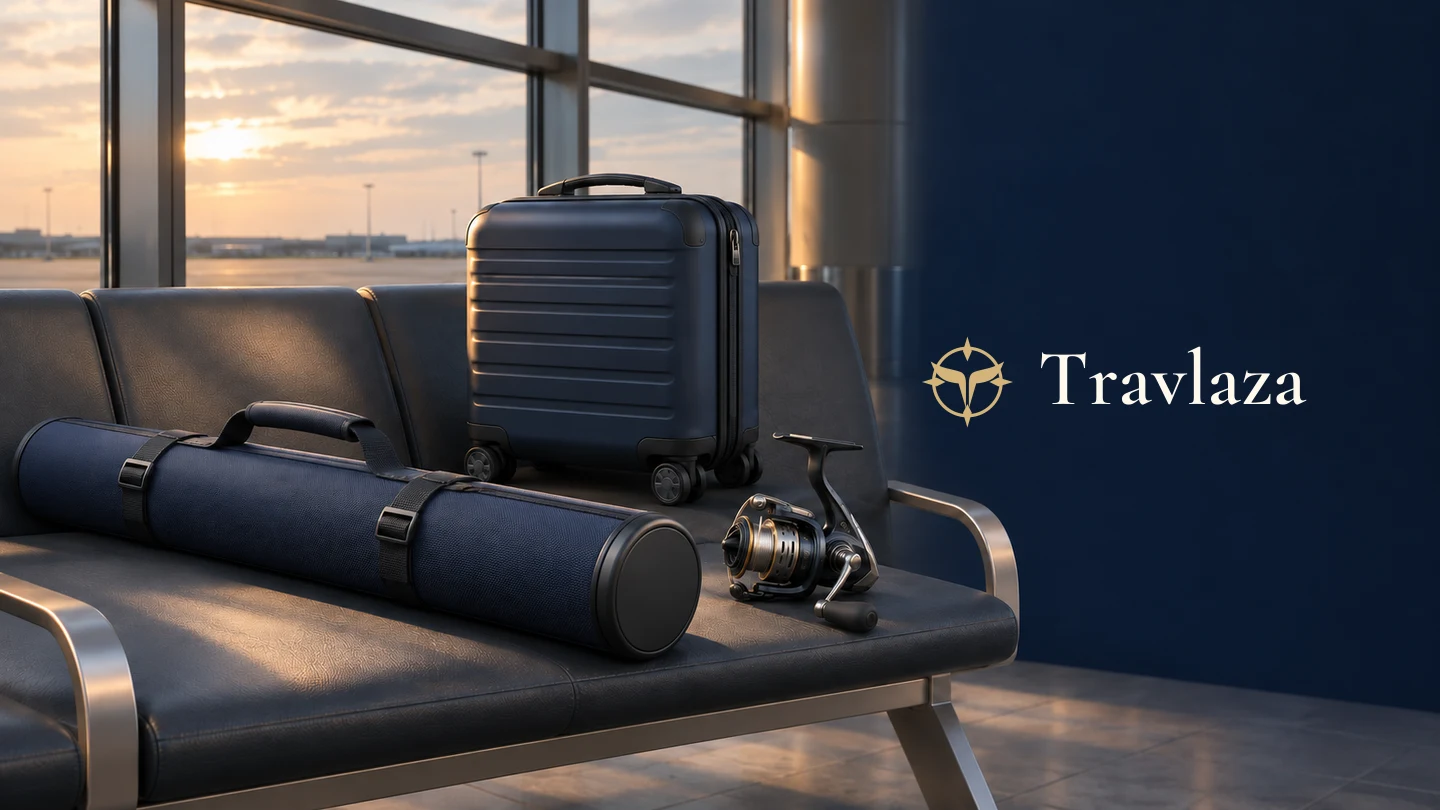
You can fly with a fishing rod when your airline accepts its packed size and the way you plan to carry it. A short, sectional rod may fit the cabin allowance; a long rod tube usually needs a checked-baggage plan. Start with the case you will actually take, then compare flights. Delta and American illustrate why a general answer such as “fishing rods are allowed” does not tell you how many bags you will pay for or where the rod can travel.
Measure the packed case first
Put the rod sections, protective sleeves and anything else that belongs in the case together before measuring. Record the outside length, width and height, including caps, handles and protruding fittings. The assembled length printed on the rod is not the measurement the airline needs. A rod that breaks down into several short sections can lead to a different baggage choice from a two-piece rod of the same fishing length.
Keep two measurements distinct. The longest side is the case’s length from end to end. Linear size means length plus width plus height. For example, a hypothetical tube measuring 80 by 8 by 8 inches has a linear size of 96 inches, not 80. Passing a linear-size limit does not make that tube suitable for a cabin compartment. Use the measurement specified for the baggage option you want.
When a rod can travel in the cabin
Delta’s fishing-equipment policy allows fishing poles as carry-on baggage when they meet its 22 by 14 by 9 inch carry-on standard. That makes the packed dimensions of a compact travel rod worth checking. A narrow tube that is longer than 22 inches does not meet this stated standard just because it is easy to hold. If your case is outside those dimensions, arrange a checked option rather than relying on spare space above the seats.
Ask the operating airline whether the rod case uses your normal carry-on allowance and what else you can bring with it. You might need room for a reel, medication, documents and your personal items as well as the rod. If an airline says the case can travel in the cabin, also ask what to do if staff need it checked at the airport. Pack it so you can remove essentials without unpacking everything in the boarding line.
Does permission to bring the rod also cover everything in my tackle box?
No. Review the contents separately, including knives, cutters and hooks. American lists metal knives of any length as checked-baggage items, not cabin items. A practical approach is to secure sharp tackle and tools in checked baggage and confirm the restrictions for each item before leaving. The rod’s baggage acceptance does not settle security screening.
Checking a longer case with Delta
Delta accepts safely contained fishing poles as checked baggage up to 115 linear inches, or 292 cm. Its sports-equipment guidance requires a durable protective container designed for the equipment. Standard baggage allowance and charges depend on the cabin, travel region and number of checked items. Fishing equipment over 50 pounds attracts the applicable excess-weight charge; items beyond the baggage allowance can also attract additional charges.
Measure and weigh the finished case before asking for a baggage estimate. Give the airline the numbers and your flight details, rather than asking only whether it carries fishing gear. If you also have a suitcase or separate tackle bag, include those in the question. A rod case that the airline can carry may still change the cost of the trip, and another carrier’s way of counting equipment bags may be different.
American’s rod-case and tackle-bag rule
American describes one rod case containing up to two rods plus one equipment bag or tackle box as one checked item under its fishing-equipment conditions. Its listed equipment includes two rods and one reel in a case, tackle, a landing net, fishing boots and one properly encased pair of waders. Standard checked-bag fees apply within the stated allowance; counting the pieces together does not itself make them free.
The combined weight matters. If the rod case and equipment bag together exceed 50 pounds, or 23 kg, American charges them as two separate items. In a hypothetical packing example, a 4 kg rod case and a 16 kg equipment bag total 20 kg. Adding another 5 kg to that bag takes the pair to 25 kg and changes that counting outcome. Weigh both pieces together as well as separately, then ask for the applicable charges for your booking.
The equipment bag has its own conditions, so avoid filling spare space with unrelated belongings on the assumption that the fishing allowance covers them. Describe what is inside when you ask American to confirm the grouping. If you need another suitcase for clothing, include it in the total bag count. Use the answer for that itinerary; do not carry American’s two-piece grouping over to a Delta flight.
Compare the fare with the baggage plan included
Set out the passenger fare, the rod case, the tackle bag and any ordinary checked suitcase for each flight option. Next to each item, note whether the quoted fare includes it or whether a charge needs to be added. Our guide to comparing baggage allowances before booking explains how to keep those comparisons consistent when fares include different bags.
Compare flight options on Travlaza once you know which baggage arrangement you need. A lower passenger fare can lose its advantage when you add another checked item, while a more expensive fare may still be poor value if your rod case cannot travel as planned. Confirm equipment acceptance and the final baggage charges with the airline before buying. Travlaza helps compare flights; you book, pay and receive the ticket through the airline or agency you select.
Check each flight in a connection
Look for the airline that operates each flight, including a connection sold under another airline’s flight number. Send the same packed dimensions and weights to each relevant operator. Ask how the equipment will be handled between flights, whether you must collect it and where it will be returned. Those answers help you decide whether a nonstop option is worth considering alongside a cheaper connection.
Think through the parts of the journey outside the aircraft too. Can you carry the tube and suitcase together from the terminal to your transfer? Does the ground-transport option work with the case’s actual length? If you must collect and recheck the equipment during a connection, plan around that process and the airline’s check-in instructions. A longer connection gives more time, but it does not change an airline’s acceptance conditions.
Pack for the handover you have arranged
Use padding to keep rod sections from knocking together inside the protective case, secure loose parts and close the case as its maker intends. Keep the packed measurements handy so you can explain the arrangement at check-in. Label the case and keep a private record of its appearance and contents. Before leaving the counter, check the destination on the baggage receipt and ask where to collect an unusually shaped item on arrival.
More travel guides
Flying with skis: count the boot bag before booking
A practical way to measure, weigh and price skis or a snowboard together with a boot bag before buying your flights.
Flying with golf clubs: plan your checked bag before booking
Choose a suitable case, weigh the packed golf bag and compare both directions of the journey before paying for a flight.
Flying with frozen food from a U.S. airport: gel packs or dry ice?
Plan which bag will hold your cooler before you book. The right choice depends on whether you can keep gel packs solid at screening or get the airline to approve dry ice.