

Flying with golf clubs: plan your checked bag before booking
Choose a suitable case, weigh the packed golf bag and compare both directions of the journey before paying for a flight.
Language
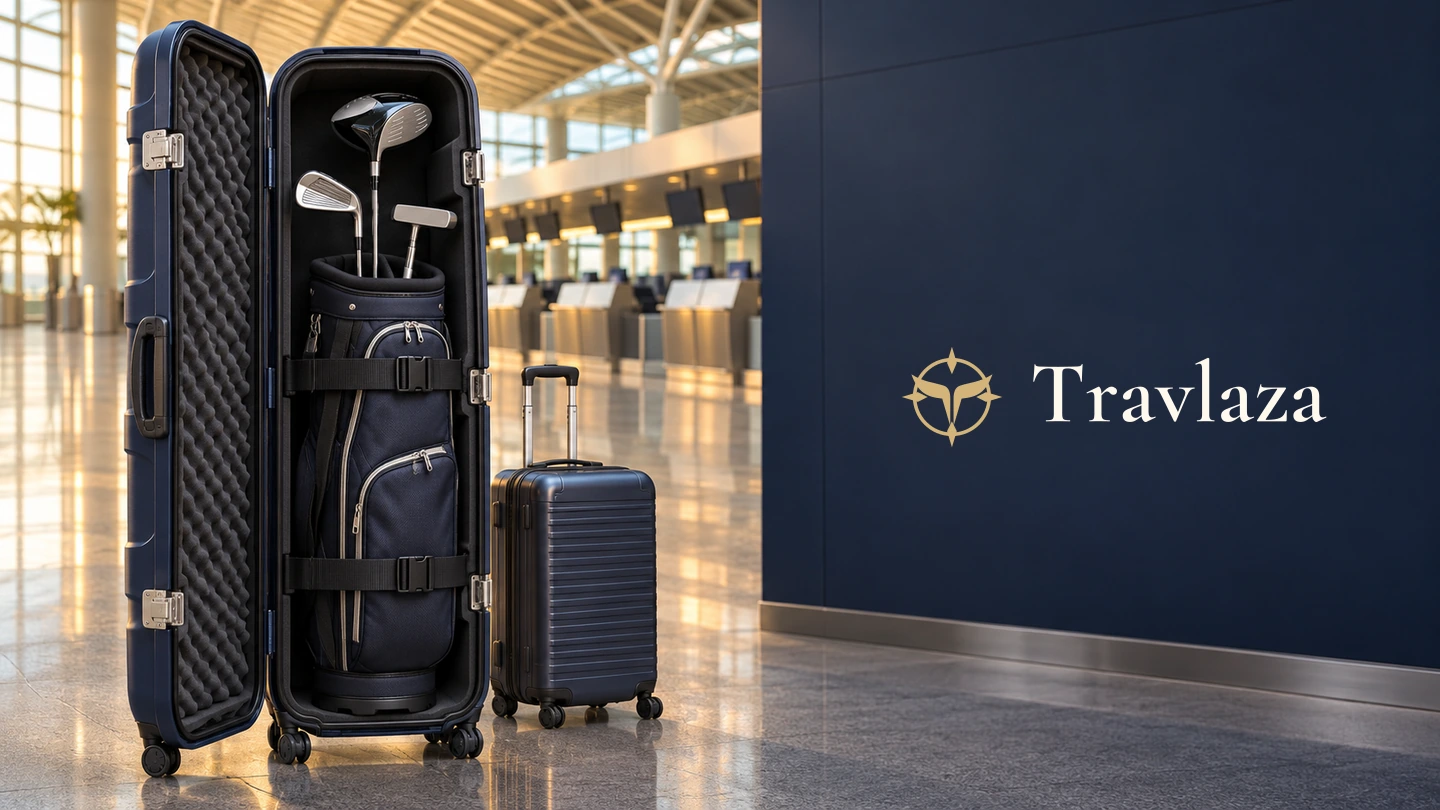
Plan to check your golf set, and settle the case and baggage charges before buying the ticket. Delta and American both describe golf bags within their checked-baggage rules, but the details matter: the packed weight, what else you put inside and the case you use can change the arrangement. Start with the equipment you actually want to take, then compare flights that can carry it on the whole journey.
Choose the case with the airline's conditions in mind
A light cover and a rigid travel case solve different packing problems. Before choosing either, weigh your golf bag with its clubs, shoes, balls and protective material. Add the outer travel case to that weight. The empty-case specification is useful when planning, but the finished piece is what needs to meet the airline's conditions. If you already own a case, pack it once at home so you can compare real measurements rather than estimates.
Measure the closed case from the outside, including its wheels, handles and other projections. Record length, width and height separately. Linear size means adding those three dimensions together; it is different from the longest side. In a hypothetical example, a case measuring 130 by 40 by 30 cm has a linear size of 200 cm. Keep both the individual dimensions and their sum available when discussing the bag with an airline.
What Delta's golf allowance covers
Delta allows one safely contained golf bag per passenger as a standard checked item within its size requirement. Its listed contents are a set of clubs, balls and tees, and one pair of golf shoes. Standard baggage charges still apply. The bag's place in your allowance depends on the cabin, travel region and other checked bags; calling it a standard item does not mean it travels free.
Under Delta's golf conditions, bags above 50 pounds attract an excess-weight charge, and bags above 115 linear inches, or 292 cm, are not accepted. Delta specifies a hard-shell case, or a soft-sided golf travel bag after a limited release has been signed. Read that release if choosing a soft bag. Delta also excludes responsibility for damage already noted at check-in or caused by overpacking; a protective case is a packing choice, not a promise that damage cannot occur.
American: contents and weight affect the golf-bag terms
American lists one golf bag containing clubs, balls, tees and one pair of golf shoes. Its destination's standard checked-bag fees apply up to 50 pounds, or 23 kg; overweight charges apply above that through 70 pounds, or 32 kg. American says oversize fees do not apply to the eligible golf bag. If you pack things other than approved equipment inside, however, it is treated as a standard checked bag and additional oversize and overweight charges may apply.
That fee waiver does not remove physical limits. American's sports-equipment maximum is 115 linear inches, or 292 cm, and 70 pounds, or 32 kg, subject to aircraft size and cargo space. There is also a separate condition for departures from Madrid: no side may exceed 43 inches, or 110 cm. A U.S. departure followed by a Madrid return therefore needs a longest-side check as well as the usual total. American also prohibits swingless golf club load strips; leave those out if you use that equipment.
Can I fill the spare space in my golf bag with clothes?
For American's golf-bag terms, keep to its approved contents or ask how the proposed mix will be charged. Its rule for unapproved items can change the oversize-fee treatment. Use a separate clothing bag in your comparison if necessary, and include that piece in the baggage total. A case with room left inside has not automatically gained a broader allowance.
Leave a workable margin when packing
Use the protection intended for your case to keep club heads and shafts from knocking together, secure loose accessories and close every fastening properly. Spread the weight so the bag is manageable when standing or rolling it. Follow the case maker's instructions for any removable parts. These are practical preparation steps; they do not replace the carrier's packaging conditions or guarantee a particular handling outcome.
Weigh again after the final additions. As an illustrative example, a packed case at 21 kg stays below American's stated 23 kg standard-fee line; adding 3 kg takes it to 24 kg and into its overweight band. Removing unnecessary balls or moving approved shoes into an ordinary suitcase may help, but weigh that suitcase too. Solving the golf bag's weight problem by making another piece overweight can simply move the extra charge.
Compare a complete price for the same equipment
For each flight option, list the golf case and every other checked piece beside the passenger fare. Note which pieces the exact fare includes, then obtain the charges for any additions or excess weight. Do this for both directions. If a price is still missing, keep the total incomplete until the airline or agency answers; an unquoted golf-bag charge is not a zero.
Our guide to comparing baggage allowances before booking helps when fares include different bags. The useful comparison is the final cost for your packing plan. A fare including a suitcase might still need another paid item for the clubs. Another fare may start lower and remain cheaper after that addition. Include any case you need to obtain and the ground transport required to carry it, without treating an equipment fee waiver as a discount on the whole trip.
Make the connection work for the golf case
Identify the airline operating every flight, especially where a connection is sold under another carrier's name. Send each relevant airline the packed dimensions, weight and case type with your flight details. Ask whether the equipment can travel on that aircraft and how the applicable allowance will be counted on your ticket. Our guide to operating airlines and codeshares explains where to start when the names differ.
Ask whether the case will be tagged to the final destination or whether you must collect and check it in again. If collection is required, compare the actual transfer process as well as the connection time. Think through carrying a large case alongside your suitcase between terminals or onto ground transport. A nonstop flight may simplify that handling, but compare its complete price and equipment acceptance rather than assuming it is always the better value.
Keep the handover and collection details with your trip
Before departure, confirm the equipment drop-off location and the airline's deadline for handing it over. Take private photos of the packed case and its contents, and keep its measurements with the booking details. At check-in, check the destination on the baggage receipt and ask where a large golf case will be delivered on arrival. Plan the journey away from the airport around the closed case, not just the smaller golf bag inside it.
More travel guides
Flying with skis: count the boot bag before booking
A practical way to measure, weigh and price skis or a snowboard together with a boot bag before buying your flights.
Flying with fishing rods: carry-on or checked baggage?
Measure the packed rod case, choose cabin or checked carriage, and compare the full baggage cost. Delta and American show how the decision can change.
Flying with frozen food from a U.S. airport: gel packs or dry ice?
Plan which bag will hold your cooler before you book. The right choice depends on whether you can keep gel packs solid at screening or get the airline to approve dry ice.