

Flight diverted: how do you reach your booked destination?
A practical plan for reaching the destination on your ticket after landing at another airport.
Language

If your flight lands at a different airport, ask the airline how it will get you to the destination on your ticket before arranging your own journey. The answer may be another flight, a coach, a train or an agreed transfer. Where passenger-rights rules apply, the airline may have to provide or pay for that transport. The exact duty depends on the route, airline and circumstances; landing somewhere else does not by itself guarantee a taxi refund or cash compensation.
Get the onward plan before leaving the airport
Start with two airport names: where you have landed and where your ticket says you should arrive. Then ask the airline operating your flight, or its ground staff, what happens next. “Transport is being arranged” leaves several practical questions unanswered. You need a destination, a departure point, a time and confirmation that there is a place for you and everyone travelling with you.
- Where does the transfer finish: the booked airport or another place we have agreed?
- Where do we meet, when should we be there, and is our place confirmed?
- What happens to checked bags, and do we need to collect them before boarding the transfer?
- Who should we contact if the transfer does not arrive or the next flight is no longer possible?
Tell staff at this stage if you need step-free transport, help with luggage or another specific form of assistance. A coach departure time is not enough if you cannot use the coach. Ask for the arrangement in a message or take a note of the details and the time you received them. Follow crew and airport instructions about remaining on board, disembarking and moving through controlled areas.
Does a diversion mean I can enter the country where we land?
No. An unexpected landing does not automatically give you permission to enter that country. Before leaving the transit area or booking a hotel outside the airport, ask airline and border staff what you can do with your documents and how any onward transfer will work.
Which rules cover the transfer?
The route and operating airline matter more than the website where you bought the ticket. Under EU passenger-rights guidance, flights within the EU and flights departing the EU are covered whether the airline is EU-based or not. Arrivals from outside the EU generally require an EU airline. Benefits already received under relevant non-EU law also need to be considered. Give the airline the actual itinerary and details of any help already provided when asking which rules govern your case.
For a covered diversion to another airport serving the same town, city or region, the airline bears the transfer cost to the airport you booked, or another nearby destination agreed with you. That last part matters: a stop elsewhere is not automatically the destination you accepted. If a proposed drop-off works for you, confirm it with the airline rather than assuming the transfer continues to your home or hotel.
For a covered EU journey, landing outside the same town, city or region is normally treated as a cancellation. The guidance makes an exception where you accept comparable re-routing at the earliest opportunity to your original destination or another destination you agree with the airline. Its Venice–Bologna example explains that travellers left to arrange their own journey to Venice can claim those transport costs; if the airline provides onward transport, such as a bus or taxi, the flight is treated as delayed. This is an EU example for a covered journey, not a rule that every diversion worldwide follows.
What the Heathrow example shows
After Heathrow closed on 21 March 2025, the UK Civil Aviation Authority said that airlines should provide onward transport to Heathrow for diverted flights covered by UK passenger-rights legislation. That transport could be by other means than flying. Its guidance also required care proportionate to the wait and said airlines unable to provide care or onward transport should promptly reimburse passengers making their own reasonable arrangements.
This was guidance for that dated incident, not a report of a current airport closure. UK protection covers departures from the UK and arrivals into the UK on UK or EU airlines; different rules may apply to other arrivals. The useful lesson is to separate the journey the airline still needs to arrange from any later compensation claim.
If you are considering paying for transport yourself
Ask what the airline can provide and whether it will authorise the alternative you are considering. Explain the actual choice: a train to the booked airport, for example, rather than simply asking whether “travel expenses” are covered. Ask how to submit the claim and what evidence is needed. Written confirmation helps record the agreement, but seeking approval is practical advice, not a universal legal condition for every valid claim.
If nobody responds and you need to act, keep the unsuccessful contact attempts and the options available at the time. Save itemised receipts and evidence of why the option you chose was reasonable. An expensive private car chosen despite an available suitable transfer may raise a different question from the only workable transport late at night. A receipt proves expenditure; it does not alone prove that every cost must be reimbursed.
If a replacement flight is genuinely needed, you can compare available flights on Travlaza while discussing the existing booking with the airline. A search result is not an airline-approved replacement or a reserved seat. Booking, payment and ticket changes are handled by the airline or travel agency you choose.
An example to help you compare the options
Imagine your flight was booked to Airport A but lands at Airport B. Staff offer a coach to Airport A, while a train could reach it earlier. Before buying the train ticket, ask when the coach actually leaves, whether you have a place, and whether the train cost would be accepted instead. Include the time needed to collect bags and get to the station. The earlier train departure may not produce an earlier arrival once those steps are included.
If you agree to finish at a nearby station instead of Airport A, record that agreement and the arrival time there. In the relevant EU alternative-airport branch, the delay is assessed using arrival at the booked airport or the destination agreed with the airline after the transfer, rather than the moment the aircraft touches down at Airport B. Keep those times distinct in your notes.
Waiting overnight, bags and the rest of your booking
When covered care is due and an overnight wait is necessary, ask about accommodation, meals and how you will reach the hotel and return for onward travel. Get a meeting point and departure time for the next day. Tell staff if your medicines or essential items are in checked luggage and ask what access is possible. Do not assume bags will appear at the alternative airport or follow you onto a ground transfer automatically.
Does bad weather mean the airline owes me nothing?
Not necessarily. Under the UK and EU rules discussed here, extraordinary circumstances can affect fixed compensation without removing applicable care and re-routing duties. Transport expenses, care costs and fixed compensation are separate questions. The cause, applicable rules and what the airline offered all matter.
Give the airline details of any onward flights on the same ticket and ask what you need to do to keep the remaining flights, including your return. Contact separately booked airlines, hotels or transfer providers promptly about their own arrangements. The first airline does not automatically take responsibility for every independent booking. If the diversion affects a connection, the guide to missing a connecting flight after a delay explains the questions to raise about the next flight.
Keep one clear record for the claim
A short chronological note is easier to use than a folder of unexplained screenshots. Include your original destination, actual landing airport, the airline’s offer, any agreed change, contact attempts, purchases and arrival at the final agreed point. Save the booking confirmation, boarding pass, messages and receipts privately together. When you contact the airline, explain which transport or care cost you are claiming and attach the matching evidence, rather than combining everything into a general demand for compensation.
More travel guides
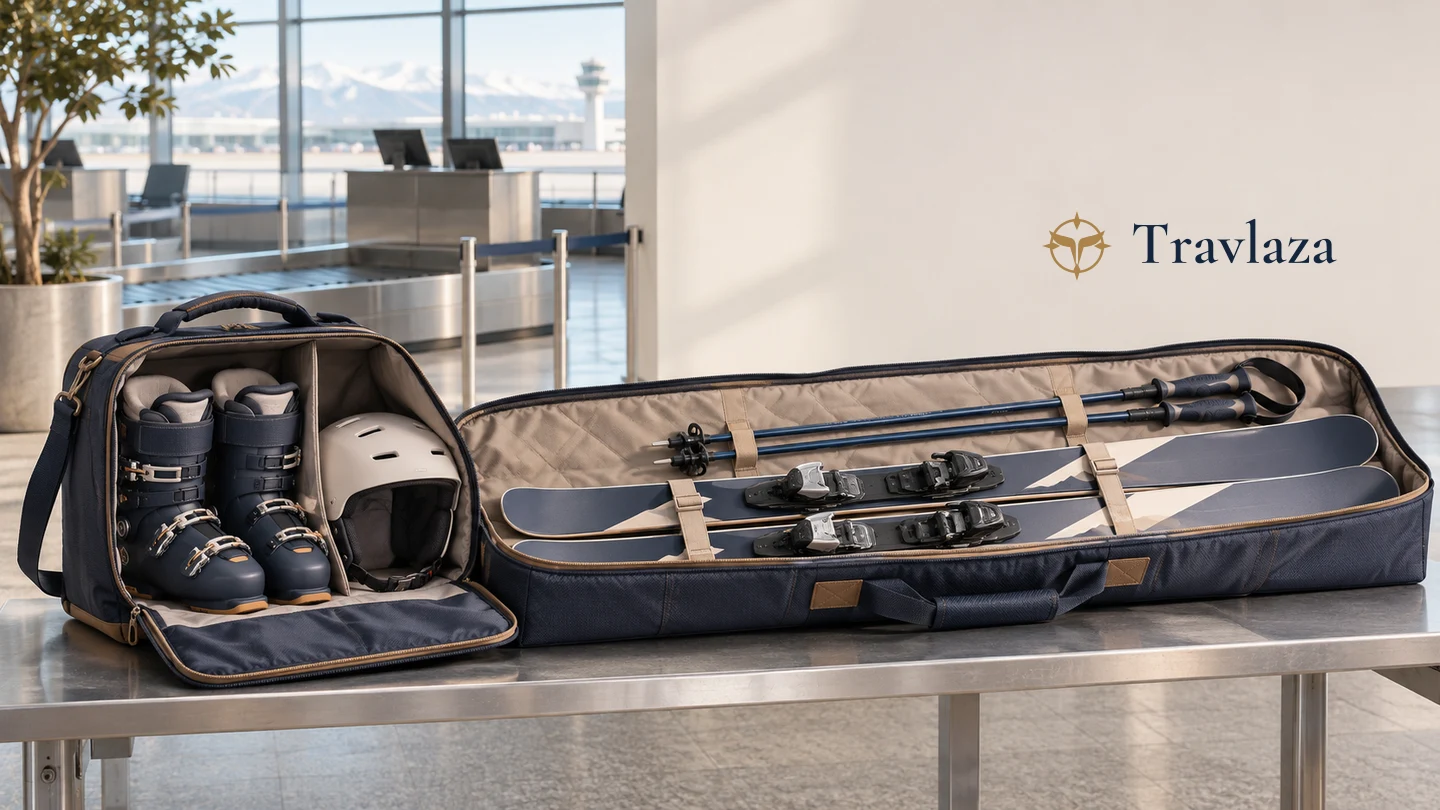
Flying with skis: count the boot bag before booking
A practical way to measure, weigh and price skis or a snowboard together with a boot bag before buying your flights.

Flying with golf clubs: plan your checked bag before booking
Choose a suitable case, weigh the packed golf bag and compare both directions of the journey before paying for a flight.

Flying with fishing rods: carry-on or checked baggage?
Measure the packed rod case, choose cabin or checked carriage, and compare the full baggage cost. Delta and American show how the decision can change.