

Flying with a portable oxygen concentrator: arrange approval before booking
Confirm your exact device, intended onboard use and battery plan with every operating airline before committing to the itinerary.
Language
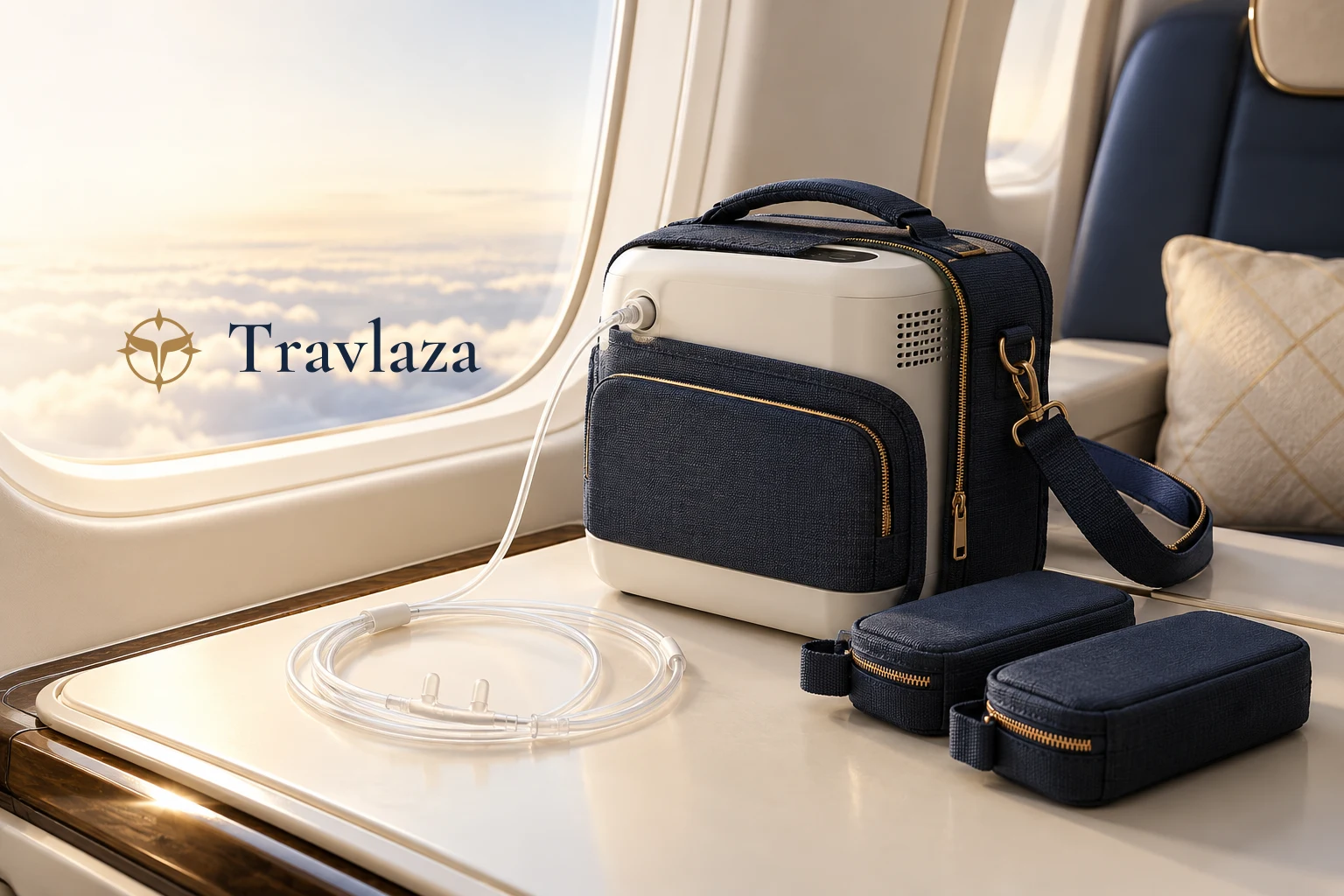
Before buying a flight, give each operating airline the exact model of your portable oxygen concentrator, explain whether you will use it onboard, and ask what clearance and battery arrangements it requires. These are separate decisions. A device accepted for carriage is not automatically cleared for use during the flight, and an assistance request in a booking is not the same as medical approval.
Start with the device and the airline flying the aircraft
A portable oxygen concentrator, often shortened to POC, has different travel requirements from an oxygen cylinder. Identify which equipment you actually have rather than describing everything as “portable oxygen”. Send the model name, a photograph of its identification label, dimensions and battery details. That gives the airline something specific to assess and avoids an answer about a different type of equipment.
Find the operating airline for every flight, including connections and the return journey. The company selling the ticket may not operate the aircraft. British Airways expressly tells passengers on partner-operated services to check the partner’s own acceptance criteria. One booking reference therefore does not remove the need to establish who handles each part of the journey.
When comparing possible itineraries, use Travlaza’s flight search to identify routes you can discuss with the operators. Complete the ticket purchase with the chosen airline or agency after the necessary arrangements are clear. Travlaza compares flights; the seller handles the booking and support. A cheaper connection is only useful if the equipment and power plan work for that whole itinerary.
What the acceptance label does and does not establish
For the operations covered by its rules, the US Federal Aviation Administration sets acceptance criteria for POCs. Unless a device was already listed under the earlier rules, it must carry the manufacturer’s label confirming conformity with those criteria. Previously listed devices have an exception to this newer label requirement. The current system therefore does not mean that the FAA individually approves every new model, nor that all accepted older models must have the newer label.
Ask the operator which evidence it needs for your particular model. A photograph of the label and the manufacturer’s documentation can answer a device-identification question; they do not establish whether the passenger has completed the airline’s medical process. Keep the equipment discussion and the medical paperwork clearly identifiable in your correspondence so that a reply about one is not mistaken for a decision about the other.
Can I bring a concentrator without being allowed to use it?
Yes, some airline rules distinguish transport from onboard use. Southwest, for example, allows transport of a POC that is not approved for inflight use but prohibits using it onboard. It may ask for medical documentation if its staff believe oxygen will be needed to complete travel. That is Southwest’s provision, not permission that applies automatically on another airline. Explain your intended use when asking your actual operator.
Arrange medical paperwork on the airline’s timetable
British Airways requires medical clearance if you expect to use a POC during the flight. Its medical-clearance form has a passenger section and a section for the doctor. BA asks for the completed medical forms to be sent at least seven days before departure. This is a BA timetable, rather than a universal deadline for all airlines or a promise that every request will be accepted.
Contact the relevant team early enough to resolve questions before committing to unsuitable flights. Ask which form applies, who completes it, how it should be submitted and what confirmation you will receive. A request marked as sent or added to the booking can still await assessment. Keep the reply privately with the itinerary and distinguish an acknowledgement of receipt from clearance to travel with the proposed arrangements.
Medical suitability and prescribed settings belong with the clinician and the airline’s required medical process. For travel planning, your task is to communicate the agreed equipment and intended use accurately. A different model, changed flight or replacement operator may require another check even when you already have paperwork for the original plan.
Build a battery plan that matches the calculation
Seat power is not a dependable backup: BA says it cannot guarantee an onboard power supply. Ask how much fully charged battery runtime the operator requires, what period it measures and which battery models, capacities and quantities it accepts. Use the manufacturer’s runtime information for the clinician-prescribed setting. A headline runtime for another setting is not a sound basis for the journey.
The basis matters when a rule uses 150%. Southwest specifies at least 150% of the expected maximum flight duration. BA’s general POC section refers to 150% of the entire travel time, including flights and transit, while its short-haul section describes flight duration. Ask BA to confirm the calculation for your itinerary rather than silently using the shorter period. Time spent changing aircraft can make a considerable difference to the plan.
As a hypothetical calculation, if the operator confirms that six hours is the applicable duration, 150% means nine hours of usable battery runtime under the agreed conditions. It does not mean nine batteries or establish acceptance of a particular battery pack. Work out the quantity using the actual device and battery information, then have the operator confirm that quantity and packaging.
Provide the watt-hour rating, model and number of each battery. BA’s page contains different battery descriptions in its general and short-haul sections, so a single numerical limit copied without context can be misleading. Ask its medical or dangerous-goods team about the exact pack, including whether a double pack has electronically separated batteries. A photograph of the rating plate is more useful than adding figures together and assuming the result is acceptable.
Spare lithium batteries belong in hand baggage with protection against short circuits. Confirm the required packaging with the airline and keep the accepted packs identifiable. If a cabin bag is later sent to the hold, bring the spare-battery arrangement to the staff’s attention before handing it over. The accepted battery plan should remain workable throughout the journey.
Include the airport and every connection
Plan equipment use and support between flights as well as in the air. BA does not provide oxygen on the ground at an airport. Its own long-haul therapeutic-oxygen service has limited availability and needs discussion before booking; short-haul sectors require eligible passenger-arranged provisions with clearance, including short-haul connections within a long-haul itinerary. Those arrangements cannot be inferred from a service available on the longer flight.
Oxygen cylinders have separate acceptance conditions. Approval of a POC does not authorize a cylinder instead, and liquid oxygen is forbidden under BA’s rules. If a cylinder is part of the proposed plan, describe it specifically to the operator and obtain the applicable instructions rather than treating it as a spare concentrator.
Airport mobility support is another request. The guide to arranging airport assistance can help with that part of the journey, but a wheelchair or transfer-assistance request does not arrange oxygen. Give each team the information relevant to its own service and keep their confirmations distinct.
Bring the confirmation through to boarding
Southwest checks the device with customer service and verifies the model, intended phases of use, batteries and packaging before each flight. Its seating and stowage instructions include an under-seat position and restrictions on exit-row seating. Ask your operator for its own seat, stowage and use instructions while there is still time to arrange an appropriate seat.
More travel guides
Flying with skis: count the boot bag before booking
A practical way to measure, weigh and price skis or a snowboard together with a boot bag before buying your flights.
Flying with golf clubs: plan your checked bag before booking
Choose a suitable case, weigh the packed golf bag and compare both directions of the journey before paying for a flight.
Flying with fishing rods: carry-on or checked baggage?
Measure the packed rod case, choose cabin or checked carriage, and compare the full baggage cost. Delta and American show how the decision can change.