

Flying with a dog: confirm cabin, hold or cargo before booking
A passenger ticket does not confirm your dog's place. Work through the operator, container, documents and collection arrangements before committing to a route.
Language
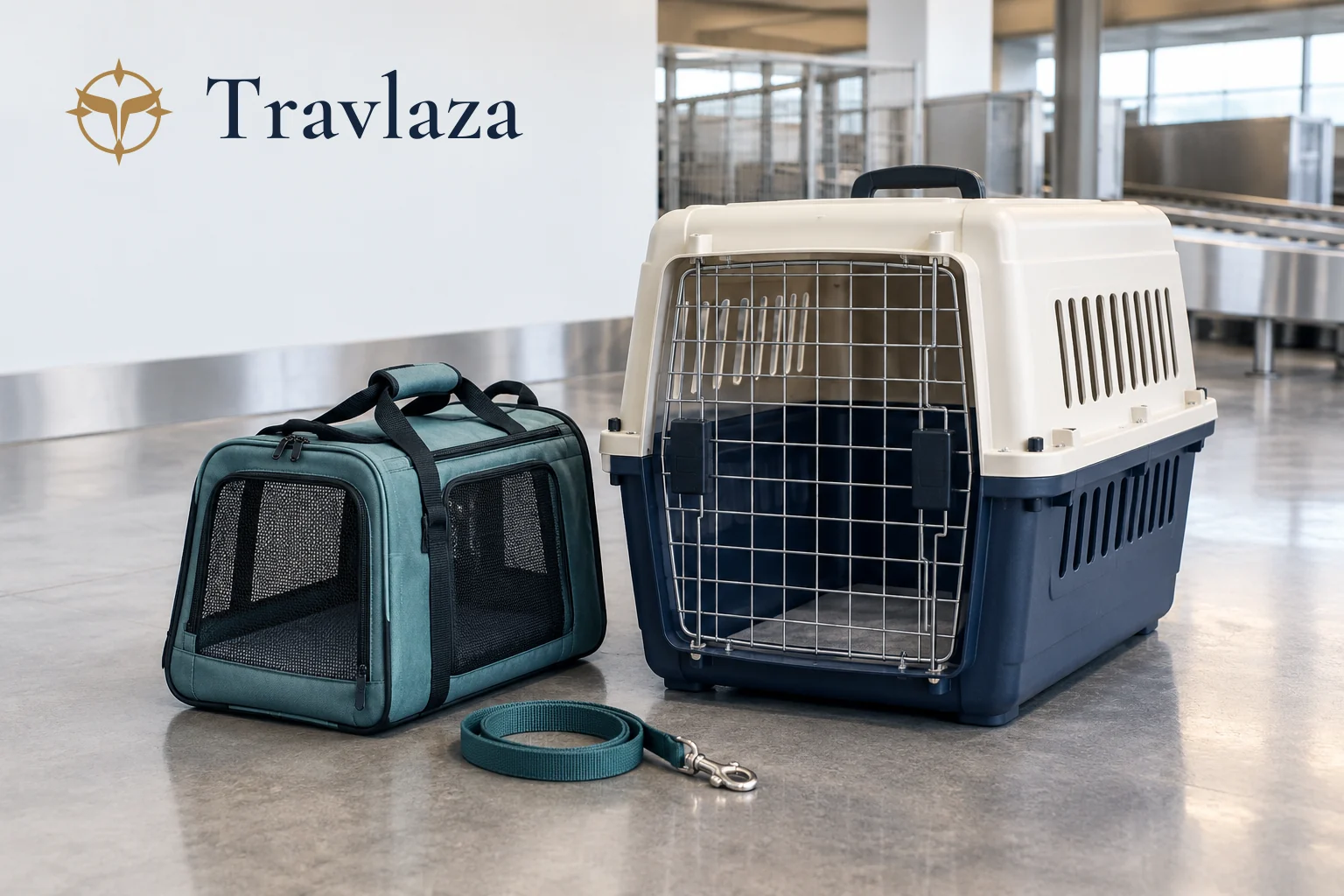
Flying with a dog starts with the airline's acceptance of your dog on the exact itinerary—not with buying your own ticket or a carrier labelled for air travel. Confirm whether each flight can take your dog in the cabin, as checked baggage in the hold, or through a cargo booking. Then check the container and the destination's entry requirements separately. A yes to one of these questions is not a yes to all three.
The useful outcome is a route you can actually arrange, with a clear handover and collection plan. This guide focuses on pet dogs. Trained service dogs have a different framework where applicable; it is not a shortcut for booking a pet. Airline examples below illustrate why the details matter, rather than recommending one carrier for every dog.
Start with your dog and the complete itinerary
Prepare a short description before contacting an airline: your dog's breed, age, weight and measurements, the container's external dimensions, and its combined weight with the dog. Include departure and arrival airports, dates, connecting flights and the return journey. Ask which details the airline needs to assess the request rather than guessing eligibility from weight alone.
Identify the airline actually operating each sector, not just the name selling the ticket. Our guide to checking the operating airline on a codeshare flight explains where to look. Send the same complete itinerary to every relevant operator. Approval for the first flight should not be treated as confirmation for a partner connection.
Record whether you plan to stay airside, collect the dog between flights, change airports or spend a night en route. These are questions for the operator and relevant authorities, not minor details to resolve after payment. If an answer depends on a flight number or aircraft, keep that condition with the confirmation.
Ask which transport option is actually available
Cabin, hold and cargo describe different arrangements. They are not three options every airline offers on every route. Ask the operator to name the service it can accept for your dog and explain who makes that booking. If it says cargo, clarify whether you must contact a cargo office or use an animal shipper, and whether your dog is expected to travel on the same flight as you.
| Arrangement | What to confirm with the operator | What not to assume |
|---|---|---|
| Cabin | Pet acceptance on the specific flight, available pet space, container limits and any seating restrictions | A small dog or a suitable-looking bag automatically qualifies |
| Checked baggage in the hold | Whether this service is offered for your dog and route, the accepted kennel and passenger check-in arrangements | A normal checked-baggage allowance includes the dog |
| Cargo | Booking contact, routing, shipper requirements, cargo acceptance location and collection arrangements | Your passenger booking also reserves the dog's shipment |
In its U.S. guidance, the FAA says airlines decide whether pets may travel in the passenger cabin. Where they do, the container must fit under the seat without obstructing access to the aisle, with proper stowage and crew instructions followed. The airline can impose additional pet conditions. This is not a worldwide cabin entitlement or a universal carrier-size rule.
Emirates provides a contrasting example: its pets policy does not permit pet dogs in the cabin. The stated falcon exception concerns specified routes between Dubai and Pakistan; it is not an exception for dogs. Depending on the circumstances, pets travel as cargo or checked baggage in the hold. Confirm the applicable arrangement directly instead of transferring another airline's cabin policy to an Emirates flight.
Keep acceptance, payment and documents in separate boxes
Before paying for your own ticket, ask how the dog's request moves from an enquiry to confirmed acceptance. A general policy page answers whether a service exists; you still need an answer about your proposed flight. Request a written record showing the route, transport mode and outstanding conditions. If the airline cannot confirm until you hold a passenger booking, ask about the sequence and cancellation terms before committing.
| Decision | Who to ask | Useful record to keep |
|---|---|---|
| Will the dog be accepted? | Each operating airline or its nominated cargo contact | Flight-specific acceptance, transport mode and conditions still outstanding |
| What am I buying? | The airline or agency issuing the passenger ticket, plus the animal booking contact | Passenger fare conditions, separate animal charges and any cargo quotation |
| Can the dog enter or transit? | The relevant official animal-entry authorities, with veterinary help where required | Applicable requirements, appointment dates and completed document references |
Once you have identified workable options, you can compare flight routes and departure times while keeping the dog's arrangements beside the passenger fare. Travlaza helps you search and compare; the selected airline or agency handles the ticket and payment. A search result does not reserve animal space or approve the dog's transport.
Do not budget from the passenger fare alone. Ask what is charged for the dog and container, who collects payment, and what changes if the itinerary changes. Emirates states that animal-and-container charges apply even when you carry no other checked baggage. That example does not establish another operator's price or terms; obtain the applicable quotation without assuming an unused baggage allowance covers the dog.
Match the container to the confirmed service
Choose the transport mode before buying the container. A retailer's description is not the operator's acceptance. Ask for the current requirements for construction, ventilation, closures, internal space and external dimensions, and how the dog and container will be measured or weighed. Check whether the answer is specific to cabin carriage, hold baggage or cargo.
IATA's pet guidance emphasises room for a dog to stand and sit naturally, turn normally and lie in a natural position. Those internal-space considerations are different from the outside dimensions the airline may request. Send both sets when asked. A container that meets one measurement test still needs to satisfy the remaining requirements for the actual service.
Keep the container model and measurements with the booking correspondence. If you replace it, ask whether the acceptance needs updating. Refer questions about your dog's fitness for the proposed journey to a veterinarian, and transport eligibility to the operator. A container comparison cannot establish that a particular dog is fit to fly, and this guide does not advise on medication or sedation.
Check entry, transit and return documents independently
Airline acceptance and permission to enter a country are separate checks. Make a document list for the destination, every relevant transit point and the return route. Ask the official authority which requirements apply to your dog's circumstances, including its travel history, and ask the airline what it needs to see before transport. Do not use the passenger's visa approval as evidence that the dog is cleared.
For a pet leaving the United States for another country, USDA APHIS advises contacting a USDA-accredited veterinarian as soon as travel is planned to work through destination requirements and paperwork. For dogs entering or returning to the United States, CDC is the primary import authority. Its requirements depend on where the dog was vaccinated and the countries it visited during the preceding six months; use the current official guidance for that situation.
Turn the requirements into a dated sequence rather than one task called paperwork. Note who issues each document, whether an appointment or endorsement is needed, when it must be completed, and who receives it. Emirates asks travellers to contact it well in advance and submit completed paperwork at least one week before the flight. This airline deadline is not a substitute for starting any longer destination process early.
Agree on handover, collection and a change of plan
Before departure, obtain the exact reporting location and time for both you and the dog. For cargo, ask where the receiving person collects the shipment and whether the facility will be open at the scheduled arrival time. IATA highlights collection-facility opening hours as an advance check. Do not assume the passenger arrivals hall is the collection point.
Keep booking contacts available offline and agree who to call if a flight time, operator or routing changes. Ask whether the revised flight still accepts the dog, whether the handover appointment changes and whether documents remain valid for the new dates. Review the return leg too. A workable outbound journey does not resolve a later change or a different return connection.
For example, imagine a proposed connection changes to an overnight stop. Before accepting it, ask who is responsible for the dog during the stop, whether collection is required and which entry rules would then apply. This is a planning example, not a claim about a particular airport. If an essential answer is missing, compare another route rather than filling the gap with an assumption.
Questions travellers ask before booking
Can my dog travel in the cabin if it fits in a small carrier?
Not necessarily. The operator must allow pet dogs in the cabin on the particular route and flight, and your dog and container must meet its conditions. Check available pet space as well as measurements. Emirates, for example, does not permit pet dogs in the cabin under its stated pets policy. Do not buy a bag or passenger ticket on the assumption that size alone secures acceptance.
Is my dog's booking included in my passenger ticket?
Do not assume so. Ask how the animal's acceptance is recorded, what charges apply and which contact handles it. A cargo arrangement may involve a different booking process and collection location. Keep the passenger ticket, animal acceptance and destination documents as separate records, then check that all refer to a compatible itinerary before you pay.
Which documents should I check for an international trip?
Check the official requirements for the destination, relevant transit points and return journey, together with the airline's transport paperwork. The exact list depends on the dog's circumstances and route. For U.S. departures, APHIS directs travellers to a USDA-accredited veterinarian early; for entry or return to the United States, follow CDC's dog-import guidance. Do not treat an airline's acceptance as border clearance.
Does calling my dog a service animal change the pet rules?
A pet does not become a service dog through a label or a purchased accessory. Under the U.S. Air Carrier Access Act framework, a service dog is individually trained to perform work or tasks for a qualified person with a disability; emotional-support and companionship animals are not service animals under that definition. On covered U.S. flights, airlines may require specified DOT forms, and applicable safety and entry conditions still matter. This is distinct from ordinary pet booking and is not a worldwide exemption.
More travel guides
Flying with skis: count the boot bag before booking
A practical way to measure, weigh and price skis or a snowboard together with a boot bag before buying your flights.
Flying with golf clubs: plan your checked bag before booking
Choose a suitable case, weigh the packed golf bag and compare both directions of the journey before paying for a flight.
Flying with fishing rods: carry-on or checked baggage?
Measure the packed rod case, choose cabin or checked carriage, and compare the full baggage cost. Delta and American show how the decision can change.