

UK airport liquid rules: how to pack for every security check
A larger bottle allowed at departure may face a different rule at the next check. Plan departure, transit and return liquids together.
Language
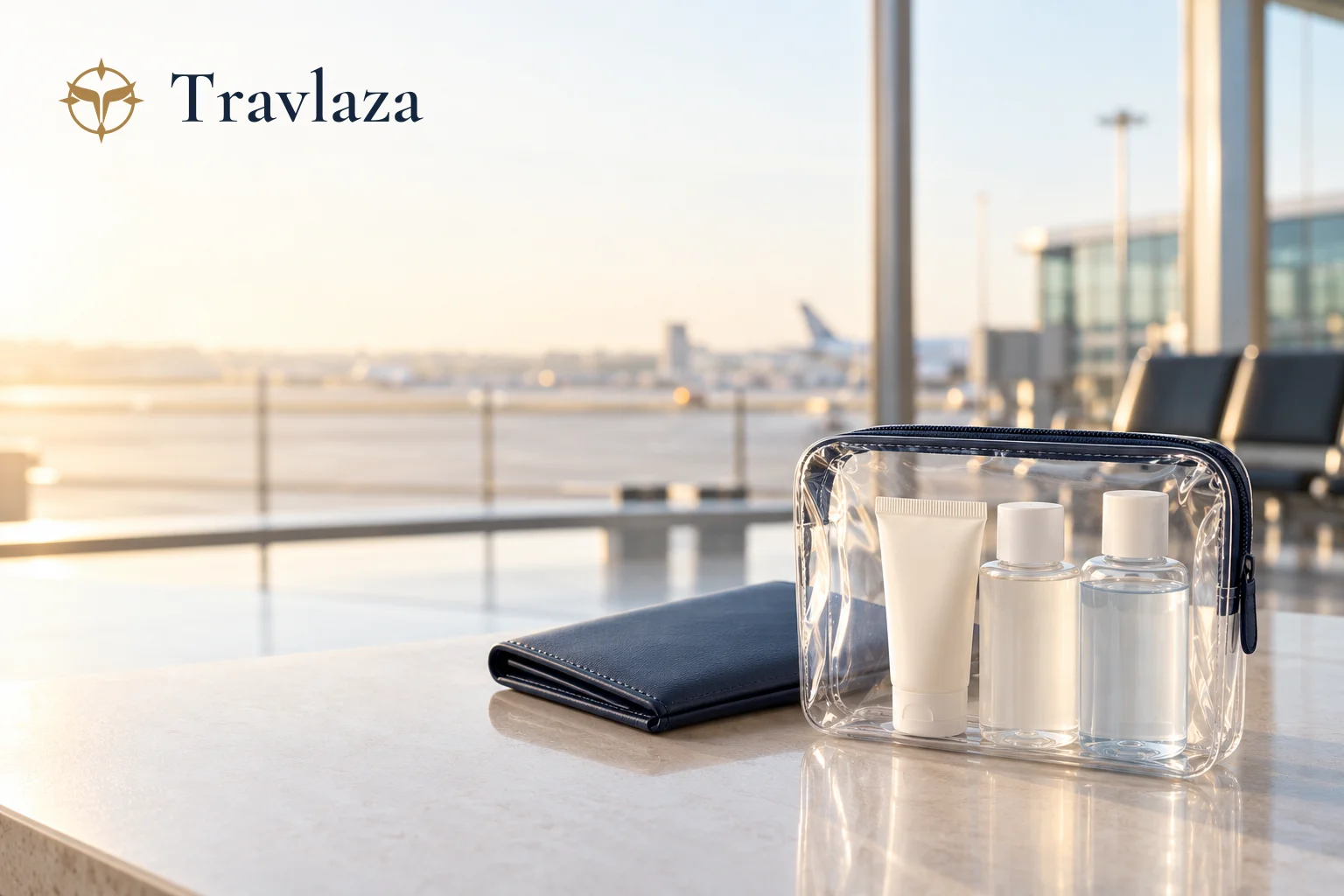
UK airport liquid rules depend on the airport where your bag is screened, and a connection can add another check. Start with your departure airport, then list every possible transit check and the airport you will use on the way home. Do not assume that a bottle accepted on the first flight will be accepted throughout the journey. Heathrow and Gatwick now describe larger-container arrangements, while other airports can still require small containers.
This guide uses official UK information checked on 16 October 2026 to help you make a packing plan for the whole itinerary. It separates ordinary toiletries, essential medicines, baby supplies and purchases made after security. The useful question is not simply how much liquid an airline allows: it is which items you will carry through each actual checkpoint, under which conditions.
Begin with the journey, then choose the containers
Write down the airports, flight dates and terminals for both directions. Add a line for any transfer where you may face another security check. A connection shown on one booking does not answer that question by itself. Ask the airport or airline about the arrival-to-departure route, including terminal changes, baggage collection and any need to leave the transit area. Mark an unanswered point as unconfirmed rather than assuming there is no check.
Keep three decisions separate. Airport security decides how items are screened; the operating airline and fare conditions determine your cabin bag allowance; destination authorities set applicable import requirements. Passing a security check does not settle the other two. For the bag itself, use the guide to baggage allowance before booking to compare included pieces, size and weight alongside the liquid plan.
When comparing itineraries, give each option its own list of unresolved screening questions. You can then compare flights for your travel dates with a clearer idea of the connection arrangements you need to confirm. Travlaza helps with search and comparison; the airline or travel agency you select handles booking, payment and ticket issuance.
What the current Heathrow and Gatwick notices actually say
Heathrow currently states that liquids in containers up to 2 litres can pass through security at Terminals 2, 3, 4 and 5 and remain inside the cabin bag. It asks travellers to empty reusable metal or insulated bottles before security, with refilling afterwards. Those details are an airport instruction, not evidence that every UK or overseas airport has the same arrangement.
Heathrow also lists a destination condition: liquid containers over 100 ml cannot be taken on flights to Australia. A general statement about the Heathrow scanners therefore does not finish your route check. If your itinerary includes Australia, confirm the applicable flight requirements with the airline before deciding which bottles to pack.
Gatwick describes containers up to 2 litres that can stay inside hand luggage, with metal or double-walled containers emptied first. Its detailed toiletries advice also uses the wording under two litres. If you intend to carry an item right at a stated boundary, ask about that exact container instead of treating slightly different wording as a promise. Open drinks in containers that cannot be resealed are not accepted through its screening.
For any other airport, read that operator’s current notice. Check the travel date and terminal when relevant. An old photo of a scanner, a friend’s experience or a headline about new equipment is a prompt to check, not a packing rule. Follow staff instructions at the checkpoint, including any additional inspection.
If a checkpoint still applies the 100 ml arrangement
Where the ordinary-liquid limit is 100 ml, read the capacity printed on each container. A partly empty larger bottle is still a larger container. For example, a hypothetical 250 ml shampoo bottle holding only 50 ml is not a 50 ml container. This example explains the distinction; it does not establish which rule applies at a named airport.
GOV.UK says that, where a separate transparent bag is required, the containers must fit comfortably in one resealable bag holding no more than 1 litre and measuring about 20 by 20 cm. It must close properly, is limited to one per person and must be presented at security. That packing method is conditional: some airports no longer require the separate bag.
Include products that are easy to overlook. Toothpaste, creams, gels, contact lens solution and foods with a liquid or paste-like consistency can fall within liquid rules. Organise by the type of product as well as the bottle size. Do not move an uncertain substance into a smaller bottle and assume that the container change resolves its classification or safety status.
Use one worksheet for every screening point
Fill in the following table before packing. Give each checkpoint its own row, including any repeated check on the way home. Record the source you checked and the date in your private notes. A useful entry says what is known and what still needs an answer, rather than simply saying checked.
| Screening point | Information to record | Packing decision |
|---|---|---|
| Outbound departure | Date, airport, terminal; ordinary container rule and bag presentation | Choose containers suitable for this check |
| Onward connection | Transfer route; whether re-screening occurs; next airport’s rules | Decide what can remain with you after the first flight |
| Return departure and transfers | New airport/terminal and any changed route or purchases | Recheck the contents rather than copying the outbound conclusion |
| Necessary liquids at each point | Medicine, special diet or baby supplies; documents and cooling questions | Keep the item and supporting information accessible |
Add the operating airline’s bag limits alongside this sheet. A larger permitted liquid container still occupies space and adds weight. If you decide to put ordinary toiletries in checked baggage, make that decision before reaching security and confirm the item is suitable for checked carriage. Keep the question of access to necessary medicines separate from the wish to reduce the number of ordinary bottles.
Plan medicines and essential dietary liquids separately
Do not treat essential medical supplies as ordinary spare toiletries. GOV.UK allows essential liquid medicines and dietary items under its exemptions. Its medicine guidance requires evidence that liquid medication is prescribed to you when its container is larger than 100 ml, such as a doctor’s letter or prescription copy. Screening can involve opening containers; essential equipment has its own screening process.
Airport pages can describe the process differently: Heathrow mentions supporting evidence when more than 2 litres of medicine is needed during the journey, while Gatwick also specifies medical documentation or named prescription labels. Carry the relevant supporting evidence and ask the actual airport about your item. Do not infer that the larger ordinary-container limit removes every documentation requirement.
For an enquiry, list the product name, container capacity, number of containers, flight dates and any cooling equipment. Ask security about screening, the airline about carriage arrangements and the appropriate destination authority about import requirements. Controlled medicines may need separate checks. Questions about treatment, dosage or changing a medicine belong with your clinician; this packing guide does not decide them.
Baby supplies need their own entry on the sheet
UK guidance distinguishes breast milk from other baby supplies. Breast milk may be carried without the baby travelling, in individual containers no larger than 2,000 ml, and must not be frozen. Formula or cow’s milk, sterilised water, soya milk and baby food have the condition that the baby is travelling. Prepare what is needed for the journey and check the actual airport’s requirements.
Containers may need additional screening or opening. Heathrow specifies clear containers or commercially available storage bags for breast milk and does not allow metal or insulated containers for it. Include the feeding supplies, container materials and any cooling packs in your enquiry. A long connection is a reason to plan access and handling early, not to assume a quantity or cooling method is automatically approved everywhere.
Think beyond the shop when buying liquids after security
A purchase after the first check may still meet another checkpoint later. UK guidance allows qualifying airport or onboard purchases through security when the items were sealed in a security bag at purchase, with the receipt inside and visible. Keep that bag sealed until the final destination. Staff may open it for screening; if another check follows, ask about the required resealing arrangements.
An ordinary clear toiletries pouch is not the same thing as a purchase security bag. Before buying a larger skincare product, show the shop your onward itinerary and ask about packaging and receipt arrangements. Independently check the transfer airport’s acceptance requirements, especially outside the UK. Neither a shop receipt nor a successful first flight is a universal guarantee.
Try the plan on three hypothetical journeys
| Example | Question to resolve | Practical next step |
|---|---|---|
| Heathrow departure, another airport for the return | Does the return airport accept the same ordinary container? | Choose the return packing method before taking a large bottle abroad |
| Gatwick departure, later security check elsewhere | What happens to a larger liquid at the next checkpoint? | Confirm that point’s rule; plan small containers or suitable checked carriage |
| Family carrying milk and prescribed liquid medicine | Which supplies, documents and containers need separate handling? | Make separate necessary-liquid entries and confirm each actual checkpoint |
These are planning examples, not confirmed flight routes or approvals. If the answer is still missing, identify the precise gap: the transfer path, product category, container size or supporting paperwork. An optional toiletry can be reconsidered; a necessary medicine calls for a confirmed handling plan. Share the enquiry response with companions together with the flight and item it covers, so a narrow answer is not expanded to everybody’s luggage.
Before leaving home and before returning
Compare the packed items with your sheet, including products added at the last moment. Refresh the airport notice when travel approaches and after a flight or terminal change. On the return, include anything bought during the trip. Keep needed documents accessible and allow for additional screening. Airport staff may refuse something they consider unsafe even when the general guidance normally allows it.
Frequently asked questions
Do all UK airports now allow 2-litre liquid containers?
No. Current UK guidance says the rules depend on the airport. Heathrow and Gatwick describe larger-container arrangements with specific conditions, but you must check every actual departure and transfer point, the return journey and any destination-related flight restrictions.
Will I go through security again during a connection?
That depends on the actual transfer route. Ask about arrival and departure terminals, baggage collection and whether you leave the transit area. Record an unanswered transfer as unconfirmed. Neither one booking nor a previous trip establishes that the next connection avoids screening.
Does a partly empty large bottle count as a small container?
Where a container-capacity limit applies, no. A 250 ml bottle with 50 ml remaining is still a 250 ml container. Read the printed capacity and compare it with the rule at the checkpoint where it will be carried.
Can I pack medicine using the ordinary liquid allowance?
Essential medicines have separate conditions. Retain prescription evidence for liquid medication in containers over 100 ml under the GOV.UK guidance, and ask each airport about screening and supporting documents for your item. Airline carriage and destination medicine-import checks remain separate.
More travel guides
Flying with skis: count the boot bag before booking
A practical way to measure, weigh and price skis or a snowboard together with a boot bag before buying your flights.
Flying with golf clubs: plan your checked bag before booking
Choose a suitable case, weigh the packed golf bag and compare both directions of the journey before paying for a flight.
Flying with fishing rods: carry-on or checked baggage?
Measure the packed rod case, choose cabin or checked carriage, and compare the full baggage cost. Delta and American show how the decision can change.